


 Order Status & Returns
 Gift Cards
 Help Center
 1-800-345-4545

Trailer Tongue Jacks
Trailer tongue jacks at JEGS include electric and manual designs that raise and lower your coupler on and off the hitch ball. You'll find 12V power jacks, topwind and sidewind manual jacks, drop leg replacements, and stabilizer, scissor and stacker jacks for leveling once you're parked. Shop by capacity, mount style and travel to match your trailer's tongue weight and frame, then use the guide below to narrow your pick.
Show More
How Does an Electric Tongue Jack for Trailer Hookups Work?
An electric tongue jack for trailer use runs a 12V DC motor that raises and lowers the tongue at the push of a button. Power comes from the trailer battery or the tow vehicle, so you skip hand cranking at every hookup. It's a common upgrade if you hitch a heavy camper or toy hauler often.
Before you buy, check how the jack gets power:
- Direct battery wiring keeps the jack independent of the tow vehicle
- 7-way plug power draws from the tow vehicle, so confirm your connector supports it
- Manual crank override lets you work the jack if the battery runs down
Ultra Fab Products offers Power Jack Ultra Series models at 3,500 lb. and 4,000 lb., including a 3,500 lb. 7-way version. Its Power Jack Phoenix line comes in 4,000 lb. and 5,500 lb. ratings for heavier tongues. If you need new plugs or harnesses, shop trailer connectors and wiring.
Manual Tongue Jacks: Topwind vs. Sidewind
A manual tongue jack uses a hand crank, so it works anywhere without power or wiring. The main difference between styles is where the handle sits. A topwind jack cranks from the top of the tube, which gives you easy access on A-frame trailers.
A sidewind trailer jack cranks from the side through a gearbox. That helps when propane tanks, a toolbox or your tailgate crowds the space above the jack. Side handles are also common on boat and utility trailers, where the top of the jack is hard to reach.
The Ultra Topwind Tongue Jack fits a 2-1/4 in. tube and is rated at 5,000 lb. For lighter loads, the Manual Jack Sidewind comes in 1,000 lb. and 2,000 lb. ratings, and the Marine Jack Sidewind is rated at 1,000 lb.
If you're still sorting out the rest of your setup, learn the different types of tow hitches. First-time towers can also start with our beginner's guide to buying a truck towing kit online.
How Do I Choose Trailer Tongue Jack Capacity?
Size your trailer tongue jack to tongue weight, the downward force the coupler puts on the hitch ball, and leave headroom. As general guidance, tongue weight is commonly about 10-15% of loaded trailer weight. A trailer that weighs 7,000 lb. loaded may put roughly 700-1,050 lb. on the coupler.
A jack rated well above that number gives you margin for shifting cargo, full water tanks and uneven ground. Undersizing can strain the gears or motor, while rating the jack to full trailer weight usually means paying for capacity you won't use. If you're unsure, weigh the tongue with a tongue weight scale before you order.
Tongue weight also changes how your tow vehicle handles. Heavier tongues often call for weight distribution hitches and sway control. Check your ball size and rating too, and browse trailer balls, mounts and components if your hitch needs an update.
How Do I Check A-Frame Tongue Jack Fit and Travel?
Start with the mount. Most A-frame tongue jacks bolt to the front of the trailer frame, so confirm the bolt pattern and tube size, such as a 2-1/4 in. tube, before you order. Then check clearance to propane tanks, battery boxes and toolboxes, and make sure your tailgate can open with the jack in place.
Travel is how far the inner tube extends. A drop leg is a removable lower section you pin at different heights, so you crank less with a tall truck or on soft ground.
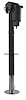
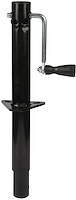
The Husky Towing Electric Trailer Tongue Jack is rated at 5,000 lb. for A-frame trailers, with 18 in. of travel and a 6 in. drop leg. If your square jack's lower section is worn or bent, CURT heavy-duty square jack replacement inner pipes with drop leg replace just that section. For more on the brand's lineup, read our CURT towing review and product spotlight.
Stabilizer, Scissor and Stacker Jacks for Leveling a Parked Trailer
A tongue jack sets the height of the front of your trailer, but it doesn't steady the frame once you're parked. Stabilizer jacks reduce bounce and rocking when people move around inside a camper. They aren't meant to lift the trailer's weight, so level with the tongue jack first and then set the stabilizers.
Ultra Fab options on this page include:
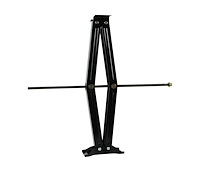
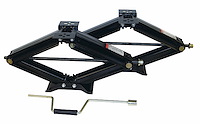
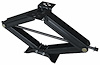
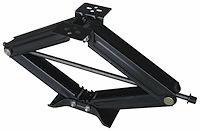
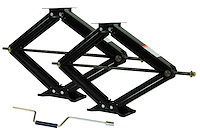
- Scissor jacks in 24 in. and 30 in. sizes, sold single or as a set of 2
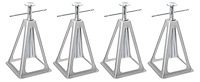
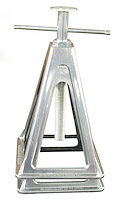
- Stacker jacks in sets of 2 or sets of 4
- Eliminator II stabilizers for front-to-back and side-to-side movement
- Drill Attachment J Hook for use with compatible jacks
Before you unhitch, block the tires with ramps and wheel chocks. Protect a parked or stored trailer with trailer and hitch locks. To finish your setup, shop all Trailer, Towing & Recovery parts.

ADD A VEHICLE TO GUARANTEE PARTS FIT
See products that fit

ADD A VEHICLE TO GUARANTEE PARTS FIT
See products that fit
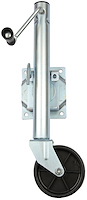
HUSKY TOWING
Electric Trailer Tongue Jack 5,000 lb. w/18 in. Travel and 6 in. Drop Leg for A-Frame Trailers [Gray]
Part Number: 066-82022
 Ships Tomorrow
 Lowest price guarantee
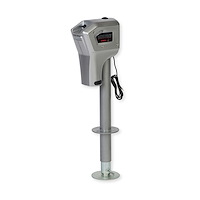
HUSKY TOWING
Electric Trailer Tongue Jack 5,000 lb. w/18 in. Travel and 6 in. Drop Leg for A-Frame Trailers [Gray]
Part Number: 066-82022
Ships TomorrowLowest Price Guarantee
CURT
Heavy Duty Square Jack Replacement Inner Pipes With Drop Leg
Part Number: 229-28957
Ships TomorrowLowest price guarantee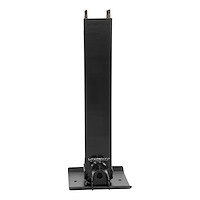
CURT
Heavy Duty Square Jack Replacement Inner Pipes With Drop Leg
Part Number: 229-28957
Ships TomorrowLowest Price Guarantee


Frequently Asked Questions About Trailer Tongue Jacks
Should a tongue jack be retracted while towing?
Yes. Crank the jack fully up before you drive, and pin or remove the drop leg so it can't drag. If you have a swivel-mount jack, rotate it to its travel position and lock the pin.
What's the difference between a swivel and a fixed tongue jack?
A fixed jack stays vertical and is common on A-frame trailers. A swivel jack pivots up to a horizontal position for towing, which adds ground clearance. You'll often see swivel jacks on straight-tongue boat and utility trailers.
What does a trailer tongue jack wheel do?
A caster wheel lets you roll a lighter trailer by hand on pavement or concrete for short moves. On gravel, grass or dirt, a flat foot spreads the load and helps keep the jack from sinking.
How do I maintain a tongue jack?
Keep the inner tube and gears clean and lubricated per the manufacturer's instructions. On an electric jack, check the wiring connections and battery charge, and test the manual override now and then. A jack cover helps protect the motor housing from weather.
Can I install a tongue jack myself?
Many bolt-on A-frame jacks install with common hand tools. Support the tongue with jack stands or blocks before you remove the old jack, and tighten the bolts to the manufacturer's spec. Electric jacks also need a secure 12V connection, so follow the included wiring instructions.