


 Order Status & Returns
 Gift Cards
 Help Center
 1-800-345-4545
 Vehicle Info Needed
 Lowest Price Guarantee
Part TypeSerpentine Belt
BrandACDELCO
Signs Of Wear & Troubleshooting - Section 1 - Bullet 1Rubber Loss: (most common belt wear) a belt wear gauge measures rubber loss, which can result in reduced power transfer from the crank to the accessories.
Faq - Answer 6No, remember the leading cause of belt failure is improper tension and misaligned pulleys. Improper tension will cause the belt to slip and you may notice a loss of performance from the air conditioning system as well as increased heat under the hood. High heat can lead to premature accessory failure.
Faq - Answer 5No, use the belt in the way it's listed in the ACDelco belts and hoses catalog.
Faq - Answer 4No, when the belt backing has been torn or cracked, the belt should be replaced.
Good Maintenance Practices - Section 1 - Bullet 1Do not use belt dressings to stop belt slippage or noise. These are oil based and may cause belt deterioration.
Faq - Answer 3Yes, the leading causes of belt failure are improper tension and misaligned pulleys. Both these conditions cause excessive heat which leads to belt failure. Have your belts checked every 3,000 miles for belt wear, proper tension, and pulley alignment.
Faq - Answer 2Yes, you may lose your power steering or stall out. Your car is not drivable when your drive belt fails.
Faq - Answer 1Yes, this may be indicative of an alignment issue or a failed tensioner.
Good Maintenance Practices - Section 1 - Bullet 4Replace V-belts after 3 to 4 years, or every 36,000 to 48,000 miles.
Good Maintenance Practices - Section 1 - Bullet 5Use an approved tension gauge to check belt tension.
Good Maintenance Practices - Section 1 - Bullet 2Never twist a belt more than 90 degrees during inspection. This may damage the tensile cords and cause premature failure.
Good Maintenance Practices - Section 1 - Bullet 3Replace serpentine belts every 60,000 - 100,000 miles. Check vehicle's owner's manual.
Features & Benefits - Bullet 2Has thermally active tensile cords that provide maintenance free performance when properly installed and tensioned
Features & Benefits - Bullet 3Manufactured with form ground to ensure precise top width and sidewall dimensional control for proper fit in the pulley as well as a smoother, quieter running belt
Top Width0.33
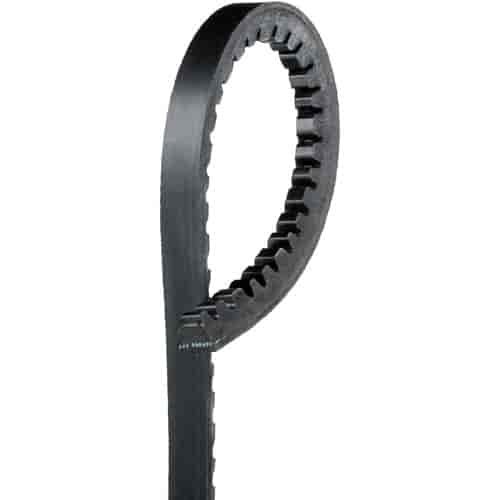
Product DescriptionACDelco Professional, premium aftermarket V-Belts serve as replacement belts for today's most demanding engine drives. Due to thermal forces, these variable notched belts actually tighten on the drive as they get hot. This results in improved belt performance by reducing tension, decay, and noise. These premium aftermarket replacement v-belts are manufactured to meet your expectations for fit, form, and function. ⚠<b> WARNING:</b> Cancer and Reproductive Harm - www.P65Warnings.ca.gov
Features &#38; Benefits - Bullet 1Its fiber loaded rubber stock puts more flexibility along the length of the belt, yet gives the belt greater lateral stability in the pulley
Effective Length940
Outside Circumference945
Top CoggedNo
ColorBlack
MaterialFiber Loaded Rubber
Good Maintenance Practices - Section 1 - Bullet 6Check for proper belt tension after 500 to 1,000 miles following belt installation. Recheck often, at least twice a year or every 6,000 miles.
Signs Of Wear &#38; Troubleshooting - Section 1 - Bullet 6Engine stops or backfires.
Signs Of Wear &#38; Troubleshooting - Section 1 - Bullet 7The belt is producing a squealing noise.
Signs Of Wear &#38; Troubleshooting - Section 1 - Bullet 8Headlights dim while driving.
Faq - Question 6Will a worn automotive belt affect gas mileage?
Signs Of Wear &#38; Troubleshooting - Section 1 - Bullet 9Loss of battery charge.
Faq - Question 5Can I use the same automotive belt for multiple uses?
Signs Of Wear &#38; Troubleshooting - Section 1 - Bullet 2Glazing: shiny spots can indicate a slipping belt that isn't properly transferring power to accessories.
Signs Of Wear &#38; Troubleshooting - Section 1 - Bullet 3Pilling: worn rubber can fill in grooves and cause noise, heat, vibration, and excessive wear.
Signs Of Wear &#38; Troubleshooting - Section 1 - Bullet 4Abrasion: wear along the side could indicate misalignment due to a failed tensioner.
Signs Of Wear &#38; Troubleshooting - Section 1 - Bullet 5Cracking: older neoprene belts crack as they near the end of their life cycle and often need to be replaced.
Faq - Question 4Is there a way to repair a torn automotive belt?
Faq - Question 3Are there steps I can take to ensure a longer automotive belt life?
Faq - Question 2Will I know immediately if an automotive belt tears?
Faq - Question 1Could an automotive belt tear during use?
Vendor Part Number15369
Package Qty1
Package TypeEA
No Questions
No Reviews
Some parts are not legal for use in California or other states with similar laws / regulations