


 Order Status & Returns
 Gift Cards
 Help Center
 1-800-345-4545
This product is no longer available. Please call customer service for assistance at 1-800-345-4545.
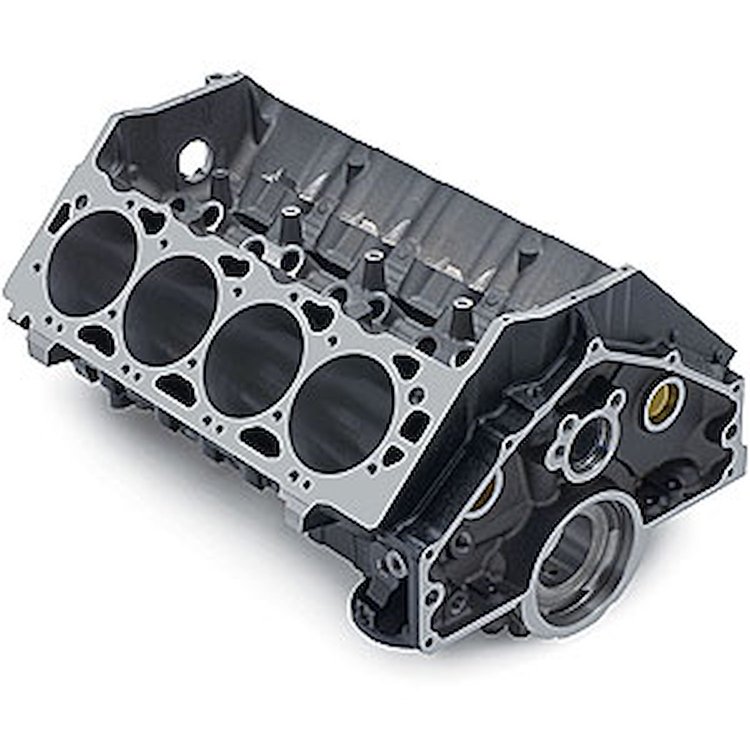
- 502 Bare Block
- 9.800 Deck Height
- 1-Piece Rear Main Seal
- 4-bolt Main Cast Iron Caps
- Max Stroke 4.250
A Better Big-BlockThe classic Chevy Big-Block production engine wasintroduced in 1965. In the late 1980s, a new versionarrived, designed for marine and fuel-injected applications.The early-style engines are known as Mark IV Big-Blocks,while the later style is referred to as the Gen V (and GenVI) Big-Block. You can tell them at a glance by checking fora mechanical fuel pump mounting pad. If it has one, it's aMark IV. If there's no fuel pump pad, it's a Gen V block.
Here's what distinguishes the latest Chevrolet Performance Big-Blocks from earlier castings:
Despite the fuel pump mounting pad difference in theircastings, the cylinder blocks of the Mark IV and Gen V arebased on the same design architecture. There are severalother differences?particularly in the water jackets near thedeck surfaces?that make some Mark IV and Gen V partsincompatible, including crucial components such as thecylinder head gaskets.
Within the last few years, Chevrolet Performance revisedthe basic Big-Block architecture to commonize the Mark IVand Gen V, creating an all-new cylinder block casting thatcombines the features of both generations. It also incorporatessignificant updates and strength-enhancing features that makethe Big-Block a stronger engine foundation with provisions tosupport 21st-century performance.
Although the basic Big-Block architecture is revised,Chevrolet Performance continues to offer two versions,each differentiated by performance and displacementcapability. The Bowtie block continues to be the block ofmaximum performance. All of our crate engines use therevised Big-Block design. - Water jackets are revised near the deck surfaces so that Mark IV or Gen V head gaskets can be used interchangeably
- Oil pressure feed holes are added to the oil filter boss and front bulk head to support oil feeds for superchargers,turbochargers, etc.
- The oil hole next to the camshaft bore at the front of the block is repositioned to enable safe machining of the cambore to accept a 50mm roller camshaft bearing
- A mechanical fuel pump mounting pad is included, similar to the Mark IV
- A boss next to the distributor hole in the valley supports hardware for digital ignition equipment
- The front bulkhead is thicker and stronger, with marked provisions for a 10-bolt timing cover (non-Bowtie blocksare delivered with drilled and tapped holes for 6-bolt covers; remaining holes must be drilled and tapped at theprescribed positions)
- Non-Bowtie blocks are machined for 4-bolt parallel main caps; Bowtie blocks are machined for 4-bolt splayed caps
- Revised rear-of-block allowed for the machining of 1- or 2-piece main seals (similar to Gen V design)
- A front clutch boss is included for older muscle car applications
- 454 blocks have a slightly beefier main web than previous blocks
- All blocks are made with the standard production roller camshaft and lifter machining
- 502 and Bowtie blocks share the same main web, which is strengthened considerably from the Mark IV and thefirst-generation Gen V Bowtie block
- Bowtie blocks feature a distinctive water jacket design to allow up to 4.600' bores. These blocks can be identifiedby a 'B' suffix behind the casting number.
- Two additional core plugs are featured in the rear bulkhead. They enhance the manufacturing process at the foundryand help improve overall quality. Also, a 'Bowtie' logo and other identifying marks are incorporated on the Bowtieblock, distinguishing it from previous generations.
Items You Need
![Engine Stand [1000 lb. Capacity]](https://www.jegs.com/images/mini_200/500/555/555-80040.jpg)
![Engine Stand [1250 lb. Capacity]](https://www.jegs.com/images/mini_200/500/555/555-80041.jpg)
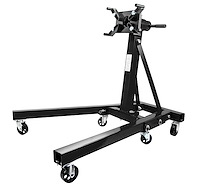
![Rotating Engine Stand [1000 lb. Capacity]](https://www.jegs.com/images/mini_200/500/555/555-80059.jpg)