


 Order Status & Returns
 Gift Cards
 Help Center
 1-800-345-4545
Engine Oil Pressure Switches, Sending Units & Adapters
Oil pressure switches and sending units let your gauges and warning lights report what's happening inside your engine. JEGS puts pressure switches, oil pressure senders, temperature senders and thread adapters in one category, with many parts ready to ship today. You can filter by part type, brand, size and material to find the pressure rating and thread that fit your build.
Show More
Oil Pressure Switch vs. Oil Pressure Sending Unit: What's the Difference?
An oil pressure switch is an on/off device, while an oil pressure sending unit sends a changing signal that a gauge turns into a reading. People often use the terms interchangeably, but the parts do different jobs. You can't swap one for the other.
A switch uses a spring-loaded diaphragm that opens or closes a circuit at a set pressure. That makes it the right part for a low-pressure warning light or any circuit that only needs to know when pressure crosses a threshold.
A sender, also called a sensor, varies its resistance or voltage in proportion to oil pressure. Your electric gauge reads that signal and shows pressure across its full sweep. If you're deciding between a sender-driven setup and a direct-line gauge, compare electric vs. mechanical gauges first. Then shop oil pressure gauges that pair with the senders in this category.
How Do You Choose the Right Oil Pressure Sender for Your Gauge?
Choose an oil pressure sender by matching four specs to your gauge: pressure range, thread size, ohm range and gauge maker. Miss one, and your gauge won't read accurately.
Start with pressure range. Senders in this category come in 80, 100 and 150 psi ranges, plus 500 psi remote sensors for higher-pressure monitoring. Pick a range that matches your gauge's scale.
Next, check the thread. Many senders use 1/8"-27 NPT threads, while some metric senders use M10 x 1K. If your port and sender don't match, you'll need an adapter.
Then confirm the ohm range. Resistance-type senders are built for a specific range, such as 120-16 ohms on a 0-80 psi sender. Your gauge must be designed for that same range.
Finally, match the gauge brand. Gauge makers specify which sender their gauges need, so check your gauge instructions before you order. For help planning a full panel, read our gauge selection guide.
What Types of Sending Units Does JEGS Carry?
JEGS carries oil pressure senders, pressure switches, remote pressure sensors, temperature senders, adapters and fuel sending units in this category. Here's what you'll find by part type:
- Oil pressure senders for electric gauges in 0-80, 0-100 and 0-150 psi ranges
- Pressure switches rated at 1, 4, 10, 15 and 60 psi for warning lights
- Remote pressure sensors rated at 150 and 500 psi
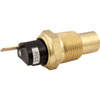
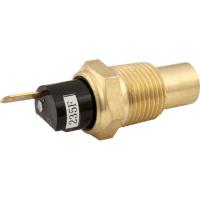
- Temperature senders with 1/8" NPT threads and 250 F or 300 F ratings
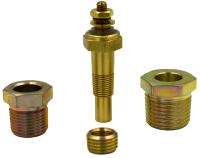
- Male T-adapters in M10 x 1K for running two devices from one port
- Pressure sender tubing kits for mounting a sender away from the engine
- Floatless fuel sending units with a 240-33 ohm range
Use the Part Type and Size filters to narrow results quickly. If you're finishing a dash install, add mounting hardware from our gauge accessories, or browse all gauges and accessories to complete the job.
Which Oil Pressure Sensor and Switch Brands Can You Shop?
You can shop oil pressure sensors and switches from Auto Meter, VDO, Stewart Warner and Racepak. Buying the sender from your gauge's maker is the simplest way to get a matched pair.
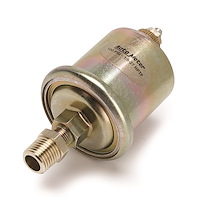
Auto Meter offers the 0-100 psi electric oil pressure sender 105-990342, which its gauges require. The lineup also includes Pro-Lite 30 psi sending units and 1/8" NPT temperature senders.
VDO carries 80 psi and 150 psi pressure senders in 1/8"-27 NPT, with 80 psi versions also offered in M10 x 1K. You'll also find a 60 psi normally open pressure switch, 250 F and 300 F temperature senders and M10 x 1K male T-adapters.
Stewart Warner covers single-circuit and dual-circuit pressure switches in 1/8 in. NPT. Its senders include the 82514 0-80 psi, 120-16 ohm unit and a 0-150 psi thick-film sender.
Racepak offers 150 psi and 500 psi remote pressure sensors plus a dedicated oil pressure sender. Use the Brand filter to see each lineup.
How Do You Install Oil Pressure Senders and Switches?
Install your sender or switch in a clean oil galley port, keep sealant off grounding threads and use the correct adapter for your thread. These steps help keep your readings accurate.
Most engines offer a pressure port in the oil galley near the oil filter or on top of the block. To see how oil pressure builds and travels through the engine, read about how engine oil systems work.
Many electric senders ground through their threads. Seal tape or thread sealant can break that ground path, and your gauge will read incorrectly. Check the product instructions before you put anything on the threads.
Don't force a mismatched thread into the port. If your engine has an M10 x 1K port and your sender uses 1/8"-27 NPT, install an adapter first. A T-adapter lets you run a gauge sender and a low-pressure warning switch from the same port.
Once you've confirmed your thread, pressure range and ohm range, shop the switches and senders on this page.

ADD A VEHICLE TO GUARANTEE PARTS FIT
See products that fit

ADD A VEHICLE TO GUARANTEE PARTS FIT
See products that fit
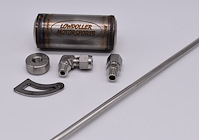
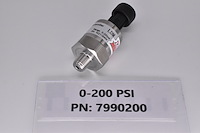
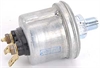
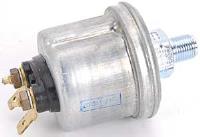

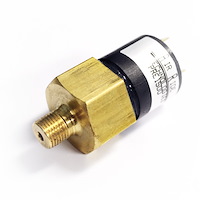
LOWDOLLER MOTORSPORTS
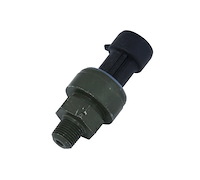
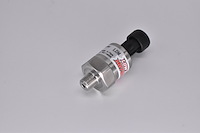
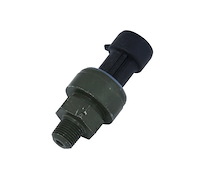
7990100-716 799-Series Pressure Sensor, 0-100 psi, 7/16 in. -20 UNF Female
Part Number: 457-7990100-716
 Ships Tomorrow
 Lowest price guarantee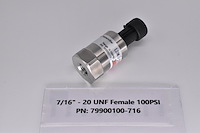
LOWDOLLER MOTORSPORTS
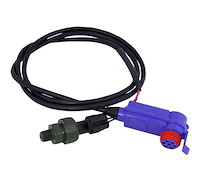
7990100-716 799-Series Pressure Sensor, 0-100 psi, 7/16 in. -20 UNF Female
Part Number: 457-7990100-716
Ships TomorrowLowest Price Guarantee
![Temperature Sensor [0-300 Degree]](https://www.jegs.com/images/mini_100/300/382/382-5005100225.jpg)
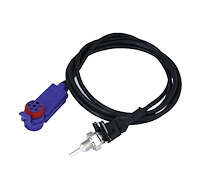
![Temperature Sensor [0-300 Degree]](https://www.jegs.com/images/mini_200/300/382/382-5005100225.jpg)

Frequently Asked Questions About Oil Pressure Switches
Can an Oil Pressure Switch Run a Gauge?
No. A switch only opens or closes a circuit at its pressure rating, so it can trigger a warning light but can't show a changing reading. To run a gauge, you need a sender that varies its signal with pressure.
What Are Symptoms of a Bad Oil Pressure Sender?
The most common sign is a gauge reading that looks wrong or inconsistent. Before you replace the sender, check the wiring and make sure the sender grounds through its threads without sealant in the way. If readings still look off, confirm actual oil pressure before you assume an engine problem.
Where Is the Oil Pressure Switch Located?
On most engines, the switch or sender threads into an oil galley port near the oil filter or on top of the block. The exact spot varies by engine. Find the port before you order so you can confirm its thread size.
Do I Need a Specific Sender for My Gauge?
Yes. Electric gauges are calibrated to a sender's ohm range, so a sender with the wrong range will throw off readings even if the threads fit. Check your gauge instructions for the matching sender part number.
What Does Normally Open vs. Dual Circuit Mean on a Pressure Switch?
A normally open switch keeps its circuit open at rest and closes it when pressure reaches the switch's rating. A dual-circuit switch has both normally open and normally closed contacts, so one switch can control two circuits. Check which action your warning circuit needs before you order.