Sign up now to join the JEGS email newsletter and be the first to learn about new products, special deals and e-mail only offers!

 2 People Found This Article Helpful

Whether you're restoring a classic Ford Mustang, researching an F-100 pickup, verifying a matching numbers Torino, identifying a vintage Bronco, or decoding the VIN on a modern F-150 or Super Duty, understanding Ford Vehicle Identification Numbers is one of the most valuable skills a Ford enthusiast can learn.
A Vehicle Identification Number, commonly known as a VIN, serves as a vehicle's unique fingerprint. Depending on the year it was built, a Ford VIN can reveal the manufacturer, vehicle line, body style, engine, model year, assembly plant, and production sequence. Earlier Ford vehicles used serial numbers and several different identification systems before the industry adopted today's standardized 17-character VIN format in 1981. Understanding which identification system your vehicle uses is the first step toward accurately decoding it.
This comprehensive Ford VIN decoder covers Ford cars, trucks, SUVs, vans, and performance vehicles built from 1946 through the present. Whether you're performing a Ford VIN lookup before buying a vehicle, researching a restoration project, confirming factory specifications, or identifying the correct replacement parts, this guide explains how each Ford VIN system evolved and how to decode it.
From postwar serial numbers and classic muscle car VINs to modern 17-character VINs, you'll learn what every section of a Ford identification number means, where to find it on your vehicle, and how to use it to better understand your Ford's history and original factory configuration.
A Vehicle Identification Number, or VIN, is a unique identification number assigned to every vehicle produced by a manufacturer. No two vehicles built within the same VIN system share the same identification number.
Ford VIN numbers serve several important purposes, including:
For classic Ford enthusiasts and collectors, VIN decoding is often the first step in determining whether a vehicle is original, numbers matching, or equipped with a desirable factory engine or option package.
The location of the VIN varies depending on the vehicle's model year.
Early Ford vehicles typically display the serial number or VIN on one or more of the following locations:
Most Ford cars and trucks built during this period have the VIN located:
Modern Ford vehicles typically display the 17-character VIN:
Checking multiple VIN locations is often recommended when verifying a vehicle's authenticity.
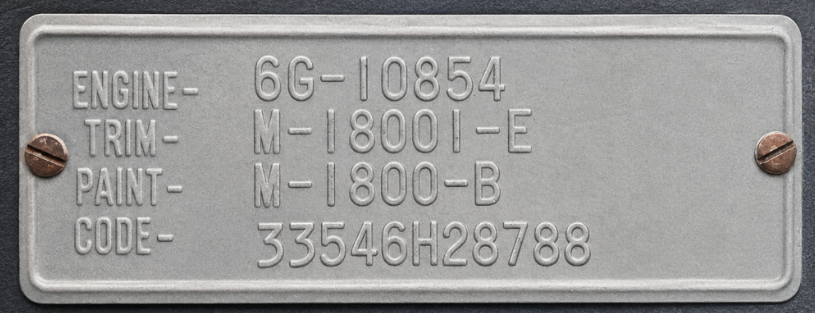
Early Postwar Ford Serial Number Systems
After World War II ended in 1945, Ford Motor Company resumed civilian vehicle production for the 1946 model year. During this period, Ford cars and trucks did not use what enthusiasts recognize today as a Vehicle Identification Number, or VIN. Instead, every vehicle was assigned a factory serial number that identified the vehicle and tracked its production.
These serial numbers were used on Ford passenger cars, pickup trucks, commercial vehicles, and chassis built between 1946 and 1948. While they contain less information than later VIN systems, they remain one of the most important tools for identifying and authenticating early postwar Ford vehicles.
Unlike modern 17-character VINs, Ford serial numbers from 1946 through 1948 were much simpler.
Rather than identifying numerous vehicle characteristics, these serial numbers primarily served to:
Information such as the engine, paint color, trim level, transmission, axle ratio, and optional equipment was generally documented elsewhere, not within the serial number itself.
Ford serial numbers during this period varied slightly depending on the vehicle and assembly plant, but most consisted of:
Most passenger cars used serial numbers containing approximately seven to eight characters, although exact formats varied throughout production.
Unlike later VINs, there was no federally standardized length.
A typical serial number looked similar to:
69A123456
or
799A654321
Although the exact format depended on the vehicle, most serial numbers contained two major components:
| Section | Meaning |
|---|---|
| Prefix | Model designation or vehicle series |
| Numeric Sequence | Consecutive production number |
The prefix generally identifies the vehicle series or model designation.
Unlike later VINs, the prefix was not intended to decode every aspect of the vehicle.
Instead, it identified the basic vehicle family used by Ford.
Examples include prefixes associated with:
Because Ford assigned different prefixes to different vehicle families, these prefixes should always be interpreted using the appropriate factory reference for the specific model year.
The numbers following the prefix represent the vehicle's production sequence.
Example:
69A123456
In this example:
123456
is the sequential production number.
This number indicates approximately where the vehicle fell within the production run.
It does not identify:
A properly decoded serial number can often help identify:
Combined with other identification tags, it can also assist in confirming:
Unlike later Ford VINs, early postwar serial numbers generally cannot identify:
These details must usually be verified using additional factory identification plates and documentation.
Depending on the vehicle, the serial number may be found on:
Some trucks may also include frame stampings that can help verify originality.
Because locations vary by model, restorers should inspect all factory identification plates before beginning a restoration.
Suppose your Ford has the following serial number:
69A123456
Here's what you can determine.
69A
Identifies the vehicle series.
123456
Identifies the vehicle's approximate production sequence.
To determine additional information such as engine specifications, trim level, and factory equipment, the serial number should be compared with the vehicle's body plate and factory production records.
Because the serial number contains limited information, Ford relied on several additional identification methods during this era.
These may include:
Often contains:
May identify:
Engine casting numbers can help determine whether the engine is appropriate for the vehicle's production period, although they do not necessarily confirm that the engine is original.
Early postwar Ford identification differs significantly from later VIN systems because there was no nationwide standard requiring manufacturers to encode detailed vehicle information into a single identification number.
As a result, accurately identifying a 1946-1948 Ford often requires examining multiple sources of information, including:
Using these sources together provides the most complete understanding of the vehicle's original configuration.
When researching a 1946-1948 Ford, keep these common misconceptions in mind:
Whether you're restoring a 1946 Ford Super Deluxe, a 1947 pickup, or a 1948 Ford passenger car, correctly identifying the serial number is the first step toward understanding the vehicle's history. Although these early serial numbers contain less information than later VIN systems, they remain an essential tool for confirming authenticity, researching production history, and ensuring your restoration stays true to the vehicle's original specifications.
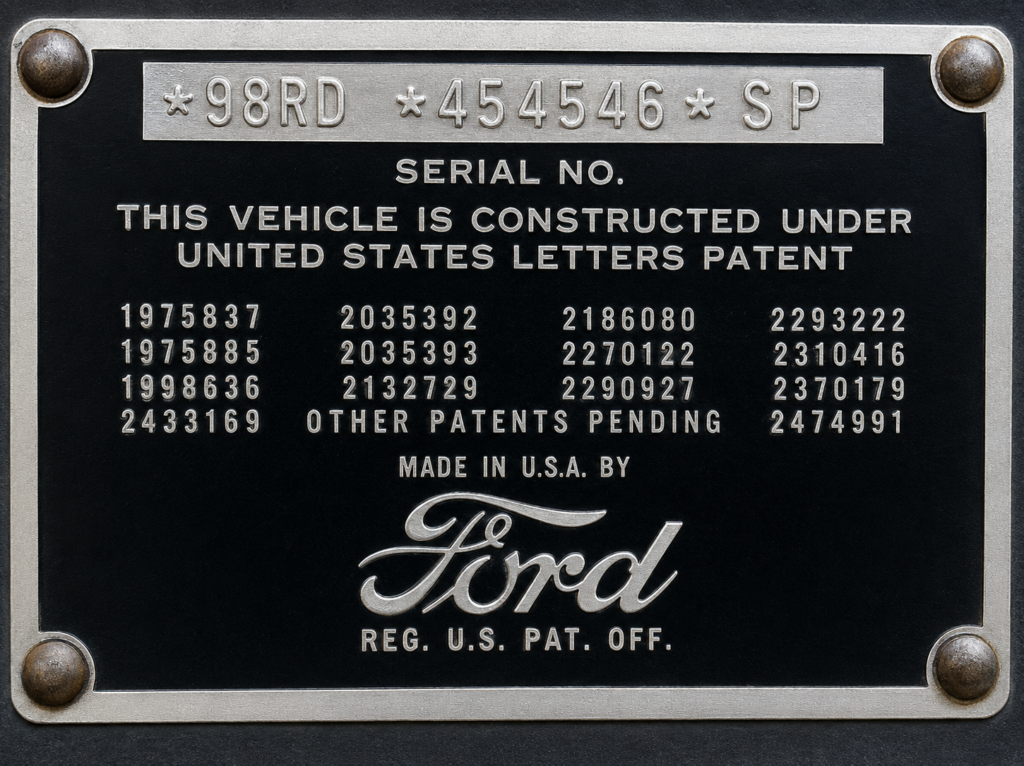
Expanded Vehicle Identification After the War
Ford continued using manufacturer-assigned serial numbers from 1949 through 1951, but this period marked the beginning of a more organized approach to vehicle identification. The completely redesigned 1949 Ford introduced an all-new body style, and as Ford's lineup expanded, vehicle identification became increasingly important for production, warranty tracking, and service.
Although these vehicles still did not use a modern VIN, the serial number, combined with the warranty plate and body identification tags, can provide valuable information about the vehicle's original identity.
Popular Ford vehicles from this era include:
Unlike later VIN systems, Ford serial numbers during this period generally consisted of:
Example:
98BA123456
The serial number primarily identifies:
Additional information such as paint color, trim, engine, transmission, and optional equipment was documented elsewhere.
Although formats varied slightly by vehicle line, most passenger cars and trucks followed a similar pattern:
Series Prefix + Sequential Production Number
Example:
98BA123456
| Section | Meaning |
|---|---|
| 98BA | Vehicle series or model designation |
| 123456 | Sequential production number |
Unlike modern VINs, the individual letters and numbers were not intended to identify every vehicle specification.
The prefix identifies the vehicle family or series.
Depending on the model year, this prefix may identify:
Ford revised many of these prefixes as new models and body styles were introduced.
Because the prefixes changed between model years, they should always be compared with the appropriate factory reference for the specific year being decoded.
The numbers following the prefix represent the vehicle's production sequence.
Example:
98BA123456
In this example:
123456
is the vehicle's sequential production number.
This number helps determine approximately when the vehicle was built during that model year's production run.
It does not identify:
When decoded correctly, the serial number can generally identify:
Combined with additional factory tags, it can also help verify:
The serial number alone generally cannot identify:
These details must be confirmed using the warranty plate and other factory documentation.
For 1949 through 1951 Ford vehicles, the warranty plate often provides considerably more information than the serial number itself.
Depending on the vehicle, the warranty plate may include:
When researching a restoration project, the warranty plate is one of the most valuable identification resources available.
Depending on the vehicle, the serial number may be located on:
Some Ford trucks may also have identifying numbers stamped into the frame.
Because identification methods varied slightly by model, inspecting every factory identification plate is recommended.
Suppose your vehicle has the following serial number:
98BA123456
Here's what can be determined.
98BA
Identifies the vehicle series.
123456
Identifies the vehicle's approximate production sequence.
To determine paint, trim, drivetrain, and factory options, the warranty plate and body identification tags should also be examined.
Because early Ford serial numbers contain limited information, restorers often use several additional identification sources.
May identify:
May identify:
Engine casting numbers help determine whether the engine is appropriate for the vehicle's production period.
Transmission casting numbers can assist in identifying the original transmission family.
When researching a Ford from this era, avoid these common misconceptions:
The 1949 through 1951 model years represent an important transition in Ford vehicle identification. While the serial number itself remained relatively simple, Ford increasingly relied on warranty plates and identification tags to document vehicle specifications. Together, these identification sources provide the information needed to research a vehicle's history, verify originality, and guide an accurate restoration.
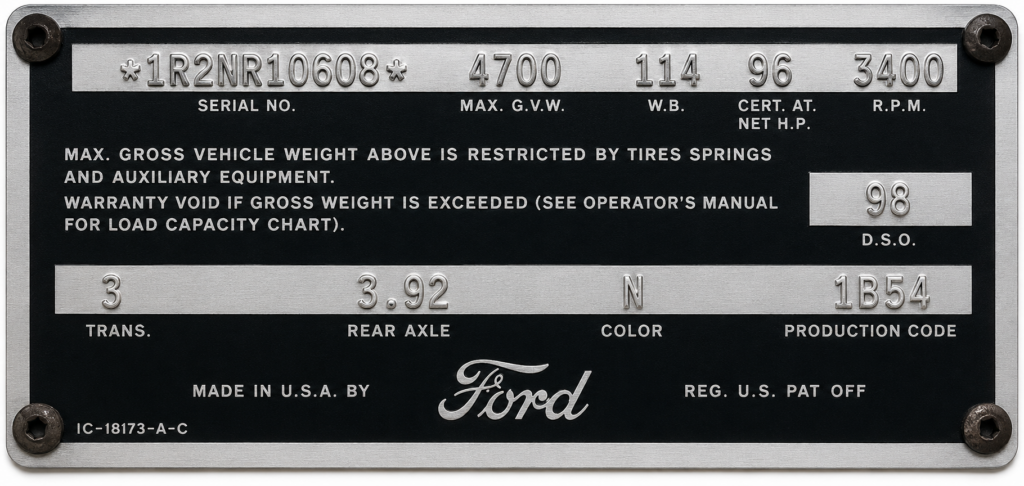
More Detailed Vehicle Identification
Ford continued using serial numbers from 1952 through 1954, but vehicle identification became significantly more organized. While these vehicles still did not use the modern Vehicle Identification Number system, the combination of the serial number and Warranty Plate provided considerably more information than earlier postwar models.
During these years, Ford introduced new body styles, additional engine options, and expanded trim levels. The Warranty Plate became an essential identification tool, allowing owners and restorers to determine many of the vehicle's original factory specifications.
Popular Ford vehicles from this era include:
Unlike later VIN systems, Ford vehicles from this period use two primary identification sources:
The serial number primarily identifies the vehicle's production sequence, while the Warranty Plate contains most of the detailed factory information.
When researching a 1952 through 1954 Ford, both should always be examined together.
Most vehicles used a serial number consisting of:
Model Prefix + Sequential Production Number
Example:
B3CG123456
Although formats varied between passenger cars and trucks, the serial number generally included:
| Section | Purpose |
|---|---|
| Prefix | Vehicle series and model designation |
| Numeric Sequence | Consecutive production number |
Unlike later VIN systems, each individual character was not designed to identify a specific vehicle feature.
A properly decoded serial number can usually identify:
The serial number alone generally cannot identify:
Those details are found on the Warranty Plate.
The Warranty Plate is the most valuable identification source on 1952 through 1954 Ford vehicles.
Depending on the model, it may include:
Because these codes vary by model year, they should always be decoded using the appropriate factory reference.
The Model Code identifies the vehicle series.
Depending on the year, this may distinguish between:
Truck model codes identify:
The Body Code identifies the original body style.
Examples include:
The exact code depends on the model year.
The Paint Code identifies the factory exterior color.
Common paint colors during this era include:
Ford periodically updated available paint colors throughout these model years.
The Trim Code identifies the original interior.
Depending on the vehicle, it may specify:
The Warranty Plate may identify the factory-installed transmission.
Common options include:
The axle code identifies the original rear axle ratio.
Common ratios vary by engine and intended vehicle use.
Knowing the original axle ratio is particularly helpful when restoring trucks or verifying performance-oriented passenger cars.
The Assembly District Code identifies the Ford assembly plant where the vehicle was built.
Depending on the year, common assembly locations include:
Ford expanded its assembly network throughout the 1950s, making this code useful for understanding where a particular vehicle originated.
On most 1952 through 1954 Ford vehicles, identification information may be found:
Some trucks also include frame stampings that can assist with verifying originality.
Suppose your Ford has:
Serial Number
B3CG123456
And a Warranty Plate showing:
Using both identification sources, you can determine much more about the vehicle than by using the serial number alone.
When researching these vehicles, keep the following in mind:
The 1952 through 1954 model years represent an important step toward modern vehicle identification. Although Ford had not yet adopted a fully decoded VIN system, the expanded information contained on the Warranty Plate allows owners to accurately identify many of the vehicle's original factory specifications. When combined with the serial number, body tags, engine casting numbers, and factory documentation, these identification sources provide a strong foundation for researching and restoring classic Ford cars and trucks.
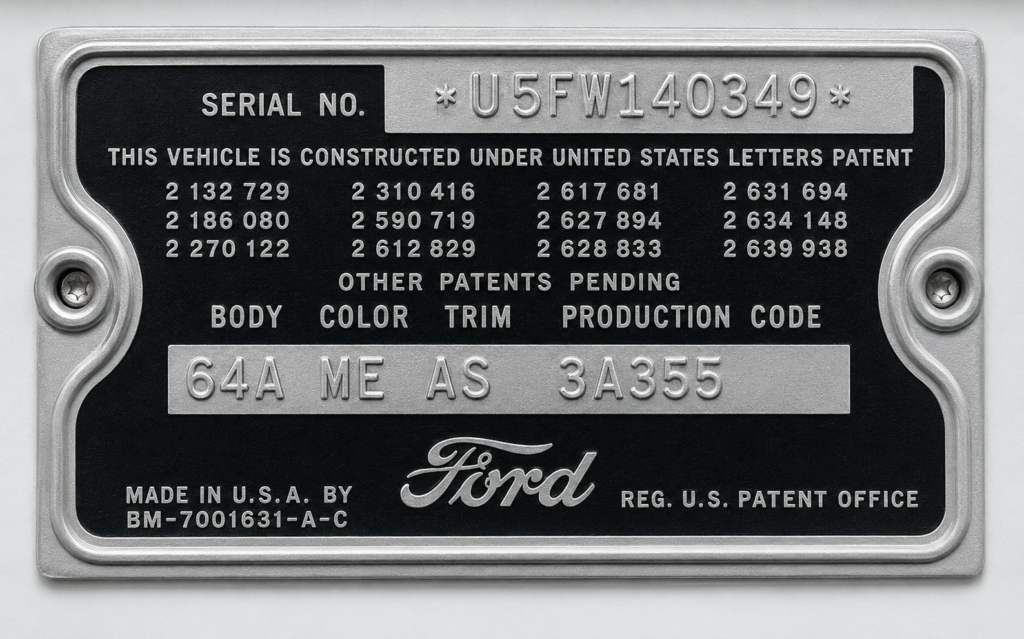
The Beginning of More Detailed Vehicle Identification
The 1955 through 1959 model years marked an important transition in Ford vehicle identification. Although Ford still used serial numbers rather than modern Vehicle Identification Numbers, the information available on the vehicle's Warranty Plate expanded considerably. Combined with the serial number, owners could determine many of the vehicle's original factory specifications.
This era introduced several iconic Ford models, including the Thunderbird, Fairlane, retractable hardtop Skyliner, Ranchero, and the redesigned F-Series pickup trucks. As Ford's lineup grew, so did the need for more detailed identification systems.
Popular Ford vehicles from this period include:
Unlike later VIN systems, Ford vehicles from this era use two primary identification sources:
The serial number establishes the vehicle's identity and production sequence, while the Warranty Plate contains detailed factory information about how the vehicle was originally equipped.
When researching or restoring a 1955 through 1959 Ford, both should always be used together.
Most passenger cars and trucks used a serial number similar to:
A5FH123456
or
H9TR123456
Although formats varied slightly by year and vehicle type, the serial number generally consisted of:
| Section | Purpose |
|---|---|
| Prefix | Model year and vehicle series |
| Numeric Sequence | Consecutive production number |
Unlike later VINs, each individual character was not intended to represent a separate vehicle specification.
A correctly decoded serial number can generally identify:
The serial number alone typically cannot identify:
These specifications are usually found on the Warranty Plate.
The Warranty Plate is the primary source of factory information for 1955 through 1959 Ford vehicles.
Depending on the model year, it may include:
Together, these codes provide a much more complete picture of how the vehicle left the factory.
The Model Code identifies the vehicle series.
Examples may include:
Truck model codes identify vehicles such as:
The Body Code identifies the original body style.
Common body styles include:
Because body code assignments changed between model years, they should always be compared with the appropriate factory decoding charts.
The Paint Code identifies the factory exterior finish.
Ford offered numerous colors during this era, including popular finishes such as:
Some vehicles were available with factory two-tone paint combinations identified by the Warranty Plate.
The Trim Code identifies the original interior.
Depending on the vehicle, this may specify:
The transmission code identifies the factory-installed transmission.
Common choices during this era include:
Knowing the original transmission is valuable when restoring a vehicle to factory specifications.
The axle code identifies the factory rear axle ratio.
Depending on the vehicle, axle ratios were selected based on:
The original axle ratio remains important when verifying authenticity.
The Assembly District Code identifies where the vehicle was assembled.
Common assembly locations include:
Assembly location can be particularly important for collectors researching production history.
Most 1955 through 1959 Ford vehicles display identification information in one or more of the following locations:
Many trucks also have frame stampings that can help verify originality.
Suppose your Ford has the following serial number:
A7FH123456
Along with a Warranty Plate indicating:
Using both identification sources allows you to build a much more complete picture of the vehicle's original factory configuration.
When researching vehicles from this era:
The 1955 through 1959 model years represent a significant step toward the detailed VIN systems that followed in the 1960s. Although Ford had not yet adopted a fully encoded VIN, the expanded information found on the Warranty Plate makes these vehicles much easier to research than earlier postwar models. By combining the serial number with the Warranty Plate, engine casting numbers, and factory documentation, owners can accurately identify many of the vehicle's original specifications and better preserve the authenticity of classic Ford cars and trucks.
Ford VIN Numbers From 1960 to 1964
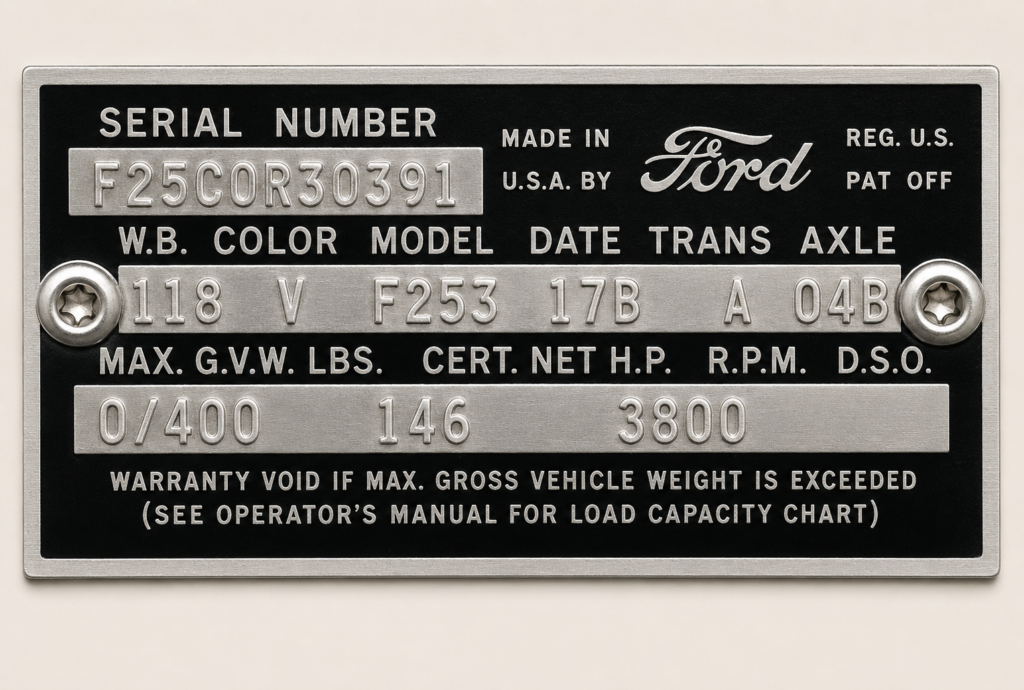
Beginning in 1960, Ford introduced a significantly improved vehicle identification system. While these VINs were still shorter than the federally standardized 17-character VINs introduced in 1981, they contained much more useful information than previous serial numbers.
For many Ford vehicles built during this era, the VIN can identify:
This makes 1960 through 1964 Ford VINs especially valuable when verifying originality, researching factory specifications, or restoring a classic vehicle.
Popular Ford vehicles from this era include:
Most passenger cars from this period used a VIN similar to:
4F27F123456
Although formats vary slightly by model, most passenger car VINs contain:
| Position | Description |
|---|---|
| 1 | Model Year |
| 2 | Assembly Plant |
| 3-4 | Body Series |
| 5 | Engine Code |
| 6-11 | Consecutive Unit Number |
Unlike earlier serial numbers, each section of the VIN now serves a specific purpose.
The first character identifies the model year.
Examples include:
| Code | Model Year |
|---|---|
| 0 | 1960 |
| 1 | 1961 |
| 2 | 1962 |
| 3 | 1963 |
| 4 | 1964 |
4F27F123456
The first character:
4
identifies a 1964 model year vehicle.
The second character identifies where the vehicle was assembled.
Common assembly plant codes include:
| Code | Assembly Plant |
|---|---|
| A | Atlanta, Georgia |
| D | Dallas, Texas |
| F | Dearborn, Michigan |
| G | Chicago, Illinois |
| H | Lorain, Ohio |
| K | Kansas City, Missouri |
| L | Long Beach, California |
| N | Norfolk, Virginia |
| R | San Jose, California |
| U | Louisville, Kentucky |
Some plant codes varied slightly by vehicle line and production year.
4F27F123456
The second character:
F
identifies the Dearborn Assembly Plant.
These positions identify the vehicle's body series and body style.
Examples may include:
Because Ford assigned different body codes to different vehicle lines, these characters should always be interpreted using the correct year-specific reference.
4F27F123456
The body code:
27
may identify a two-door hardtop depending on the specific model line.
The fifth position identifies the engine originally installed at the factory.
Engine codes vary by model and year, but common examples include:
| Code | Engine |
|---|---|
| T | 170 CID Inline 6 |
| U | 170 CID Special Inline 6 |
| F | 260 CID V8 |
| D | 289 CID V8 (late 1964 applications) |
| C | 289 CID 2V (late production) |
Some engine codes differ between passenger cars and trucks.
4F27F123456
The engine code:
F
identifies a factory 260 cubic inch V8.
The remaining digits identify the vehicle's production sequence.
Example:
4F27F123456
The final six digits:
123456
represent the vehicle's consecutive unit number assigned during production.
This number does not identify:
Let's decode the following VIN:
| Position | Value | Meaning |
|---|---|---|
| 1 | 4 | 1964 Model Year |
| 2 | F | Dearborn Assembly Plant |
| 3-4 | 27 | Body Style |
| 5 | F | 260 CID V8 |
| 6-11 | 123456 | Consecutive Unit Number |
From this VIN alone, we can determine:
Although the VIN provides much more information than earlier Ford serial numbers, the Warranty Plate still contains important factory details not included in the VIN.
Depending on the model, the Warranty Plate may identify:
Together, the VIN and Warranty Plate provide a much more complete picture of the vehicle's original factory configuration.
Most 1960 through 1964 Ford vehicles display the VIN in one or more of the following locations:
Always compare the VIN with the Warranty Plate to verify originality.
When decoding a VIN from this era:
The 1960 through 1964 model years represent a major milestone in Ford vehicle identification. For the first time, the VIN itself provides meaningful information about the vehicle's model year, assembly plant, body style, engine, and production sequence. This system laid the groundwork for the even more detailed VIN formats introduced during the Mustang and muscle car era beginning in 1965.
Sign up now to join the JEGS email newsletter and be the first to learn about new products, special deals and e-mail only offers!
The Muscle Car Era Brings Modern VIN Decoding
Beginning with the 1965 model year, Ford implemented one of its most recognizable VIN systems. While these VINs were still shorter than today's standardized 17-character format, they contained significantly more information than earlier identification numbers.
For many Ford cars and light trucks built during this period, the VIN can identify:
This era includes many of Ford's most collectible vehicles, making VIN decoding an essential part of buying, restoring, or authenticating a classic Ford.
Popular vehicles from this era include:
Most passenger cars use an 11-character VIN similar to:
6F07A123456
Although formats vary slightly depending on the vehicle line, most Ford passenger cars follow this layout:
| Position | Description |
|---|---|
| 1 | Model Year |
| 2 | Assembly Plant |
| 3-4 | Body Series |
| 5 | Engine Code |
| 6-11 | Consecutive Unit Number |
Truck VINs follow a similar concept but use different body and series codes.
The first character identifies the model year.
| Code | Model Year |
|---|---|
| 5 | 1965 |
| 6 | 1966 |
| 7 | 1967 |
| 8 | 1968 |
| 9 | 1969 |
| 0 | 1970 |
| 1 | 1971 |
| 2 | 1972 |
6F07A123456
The first character:
6
identifies a 1966 model year vehicle.
The second character identifies where the vehicle was assembled.
Common Ford assembly plant codes include:
| Code | Assembly Plant |
|---|---|
| A | Atlanta, Georgia |
| D | Dallas, Texas |
| F | Dearborn, Michigan |
| G | Chicago, Illinois |
| H | Lorain, Ohio |
| K | Kansas City, Missouri |
| L | Michigan Truck Plant |
| R | San Jose, California |
| T | Metuchen, New Jersey |
| U | Louisville, Kentucky |
| X | St. Thomas, Ontario |
Not every assembly plant built every model. For example, early Mustangs were primarily assembled at Dearborn, San Jose, and Metuchen.
These characters identify the vehicle's body style.
Examples include:
| Code | Body Style |
|---|---|
| 07 | Hardtop Coupe |
| 08 | Convertible |
| 09 | Fastback or SportsRoof |
| 33 | Two-door Wagon |
| 54 | Four-door Sedan |
| 65 | Pickup Cab |
Body code meanings vary depending on the vehicle line and model year.
The fifth character is one of the most important positions in the VIN.
It identifies the engine originally installed at the factory.
Examples include:
| Code | Engine |
|---|---|
| T | 200 CID Inline 6 |
| C | 289 CID V8 2V |
| A | 289 CID V8 4V |
| K | 289 High Performance V8 |
| F | 302 CID V8 |
| H | 351 Windsor V8 |
| M | 351 Cleveland 4V |
| Q | 351 Cobra Jet |
| R | 428 Cobra Jet Ram Air |
| J | 429 Cobra Jet |
| G | Boss 302 |
| Z | Boss 429 |
Engine codes varied considerably by model year and vehicle line. Always consult the appropriate year-specific engine code chart when decoding a VIN.
The final six digits identify the vehicle's production sequence.
Example:
6F07A123456
The last six digits:
123456
represent the vehicle's consecutive unit number assigned by the assembly plant.
These digits do not identify:
Let's decode the following VIN:
| Position | Value | Meaning |
|---|---|---|
| 1 | 6 | 1966 Model Year |
| 2 | F | Dearborn Assembly Plant |
| 3-4 | 07 | Hardtop Coupe |
| 5 | A | 289 CID V8 4V |
| 6-11 | 123456 | Consecutive Unit Number |
From this VIN we know:
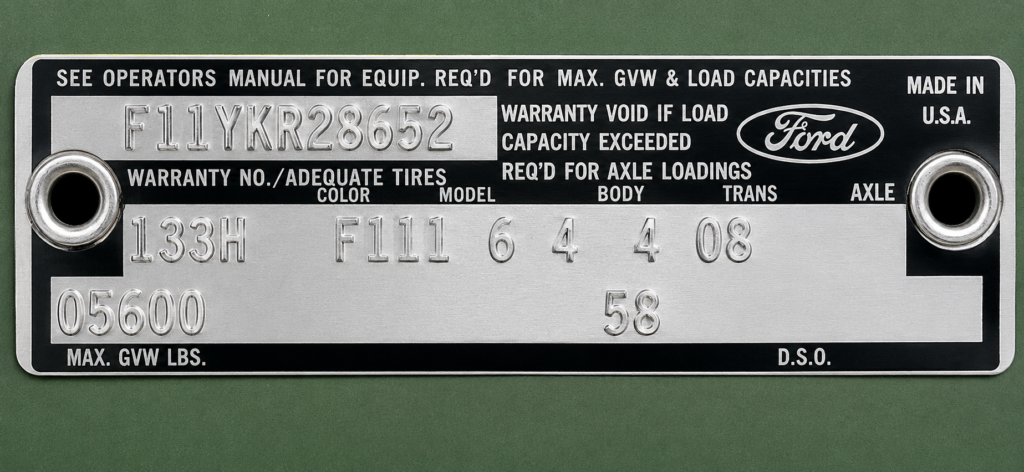
While the VIN identifies the vehicle's major specifications, the Warranty Plate contains many additional factory details.
Depending on the year and model, it may identify:
When combined with the VIN, the Warranty Plate provides a nearly complete picture of the vehicle's original factory configuration.
Depending on the model year, the VIN may be found:
Collectors should verify that all VIN locations match before purchasing or restoring a vehicle.
Ford performance vehicles from this era often command significant collector value. Vehicles such as the Shelby GT350, Shelby GT500, Boss 302, Boss 429, Mach 1, Cobra Jet, and Torino Cobra may have additional identification numbers, buck tags, or factory documentation that help verify authenticity.
For these vehicles, the VIN should always be compared with:
Using all available identification sources provides the most accurate verification of originality.
When researching a classic Ford from this era:
The 1965 through 1972 model years represent the golden age of Ford performance and one of the most important periods in Ford VIN history. These VINs provide enough information to identify the vehicle's model year, assembly plant, body style, engine, and production sequence, making them an invaluable resource for restorers, collectors, and enthusiasts. When combined with the Warranty Plate and factory documentation, they provide the foundation for verifying originality and accurately restoring many of Ford's most iconic cars and trucks.
Ford VINs Become More Standardized
Between 1973 and 1980, Ford continued improving its vehicle identification system in preparation for the federally standardized 17-character VIN that became mandatory for the 1981 model year. During this period, VINs became more consistent across Ford's passenger cars, trucks, vans, and sport utility vehicles while continuing to identify the vehicle's most important factory specifications.
For most Ford vehicles built during these years, the VIN can identify:
This era includes many popular collector vehicles and work trucks, making VIN decoding useful for restoration projects, buying classic vehicles, and verifying factory equipment.
Popular Ford vehicles from this era include:
Most passenger cars and light trucks use an 11-character VIN similar to:
8F02H123456
Although VIN layouts vary somewhat by vehicle type, most Ford passenger cars follow this general format:
| Position | Description |
|---|---|
| 1 | Model Year |
| 2 | Assembly Plant |
| 3-4 | Body Series |
| 5 | Engine Code |
| 6-11 | Consecutive Unit Number |
Truck VINs use similar principles but may use different series and body codes.
The first character identifies the model year.
| Code | Model Year |
|---|---|
| 3 | 1973 |
| 4 | 1974 |
| 5 | 1975 |
| 6 | 1976 |
| 7 | 1977 |
| 8 | 1978 |
| 9 | 1979 |
| A | 1980 |
8F02H123456
The first character:
8
identifies a 1978 model year vehicle.
The second character identifies the assembly plant where the vehicle was built.
Common assembly plant codes include:
| Code | Assembly Plant |
|---|---|
| A | Atlanta, Georgia |
| D | Dallas, Texas |
| F | Dearborn, Michigan |
| H | Lorain, Ohio |
| K | Kansas City, Missouri |
| L | Michigan Truck Plant |
| N | Norfolk, Virginia |
| R | San Jose, California (early years) |
| T | Metuchen, New Jersey (through 1973 for Mustang production) |
| U | Louisville, Kentucky |
| X | St. Thomas, Ontario |
Not every plant produced every vehicle. Some assembly plants specialized in trucks, while others produced passenger cars.
These characters identify the vehicle series and body configuration.
Depending on the model, they may identify:
The meaning of these codes varies by model line and production year.
The fifth character identifies the engine originally installed at the factory.
Common engine codes during this era include:
| Code | Engine |
|---|---|
| A | 302 CID V8 |
| H | 351 Windsor V8 |
| M | 351 Modified V8 |
| S | 400 CID V8 |
| F | 302 CID V8 (certain applications) |
| Y | 351 Cleveland V8 (early years) |
| C | 460 CID V8 (selected applications) |
| B | 3.3L Inline 6 (selected models) |
Engine code assignments changed between model years and vehicle lines, particularly as emissions regulations led Ford to revise its engine offerings.
Always use the appropriate factory reference for the specific model year being decoded.
The remaining six digits identify the vehicle's production sequence.
Example:
8F02H123456
The final six digits:
123456
represent the vehicle's unique production number assigned by the assembly plant.
These digits do not identify:
Let's decode the following VIN:
| Position | Value | Meaning |
|---|---|---|
| 1 | 8 | 1978 Model Year |
| 2 | F | Dearborn Assembly Plant |
| 3-4 | 02 | Vehicle Series and Body Style |
| 5 | H | 351 Windsor V8 |
| 6-11 | 123456 | Consecutive Unit Number |
From this VIN, we know:
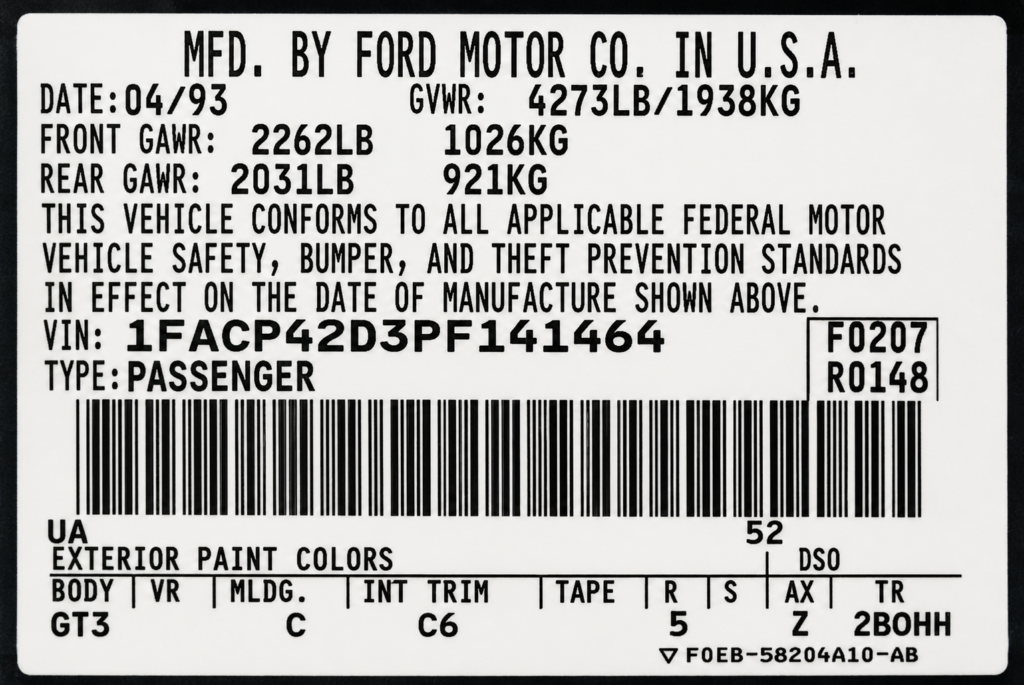
By this period, Ford increasingly relied on the Certification Label and Warranty Plate to record additional factory specifications.
Depending on the model year, these labels may identify:
Together with the VIN, these labels provide a comprehensive picture of the vehicle's original factory configuration.
Most 1973 through 1980 Ford vehicles display the VIN in one or more of the following locations:
When purchasing or restoring a classic Ford, compare all VIN locations to verify they match.
Several important changes occurred between 1973 and 1980.
These include:
These developments laid the groundwork for the federally standardized VIN system introduced in 1981.
When researching a Ford from this era:
The 1973 through 1980 model years represent the final generation of Ford's pre-standardized VIN systems. These VINs provide enough information to identify the model year, assembly plant, body style, engine, and production sequence while working alongside Certification Labels and Warranty Plates to document additional factory specifications. Understanding this VIN format is essential for accurately restoring, authenticating, or purchasing classic Ford cars, trucks, Broncos, and vans built just before the introduction of the modern 17-character VIN system in 1981.
The Standardized 17-Character VIN System
Beginning with the 1981 model year, Ford adopted the federally mandated 17-character Vehicle Identification Number (VIN) system used by every major vehicle manufacturer today. This standardized format was developed by the National Highway Traffic Safety Administration (NHTSA) and the International Organization for Standardization (ISO) to provide a consistent method of identifying every vehicle sold in the United States.
Unlike earlier Ford VINs, every character in a modern VIN has a specific purpose. By decoding the VIN, you can determine the manufacturer, vehicle type, body style, engine, model year, assembly plant, and unique production sequence.
This system is used on virtually every Ford vehicle built since 1981, including:
Every modern Ford VIN contains exactly 17 characters.
Example:
1FAFP45X1WF123456
Each position has a specific meaning.
| Position | Description |
|---|---|
| 1 | Country of Origin |
| 2 | Manufacturer |
| 3 | Vehicle Type |
| 4-8 | Vehicle Description Section |
| 9 | Check Digit |
| 10 | Model Year |
| 11 | Assembly Plant |
| 12-17 | Sequential Production Number |
The first three characters identify the manufacturer and country where the vehicle was built.
Common Ford WMI codes include:
| Code | Description |
|---|---|
| 1FA | Ford passenger vehicle built in the United States |
| 1FB | Ford bus or incomplete vehicle |
| 1FC | Ford commercial vehicle |
| 1FD | Ford incomplete truck or chassis cab |
| 1FM | Ford SUV or multipurpose vehicle |
| 1FT | Ford truck built in the United States |
| 2FA | Ford passenger vehicle built in Canada |
| 2FM | Ford SUV built in Canada |
| 2FT | Ford truck built in Canada |
| 3FA | Ford vehicle built in Mexico |
| 3FT | Ford truck built in Mexico |
1FT
identifies a Ford truck manufactured in the United States.
Characters four through eight describe the vehicle itself.
Depending on the model, these positions identify combinations of:
Because these positions vary among passenger cars, trucks, SUVs, vans, and commercial vehicles, Ford publishes separate decoding information for different vehicle lines.
The ninth character is the VIN Check Digit.
Unlike every other position in the VIN, it does not describe the vehicle.
Instead, it is calculated using a mathematical formula to verify that the VIN is valid and has not been entered incorrectly.
Possible values include:
The Check Digit is widely used by:
The tenth character identifies the vehicle's model year.
Ford follows the standardized industry format.
Examples include:
| Code | Model Year |
|---|---|
| B | 1981 |
| C | 1982 |
| D | 1983 |
| E | 1984 |
| F | 1985 |
| G | 1986 |
| H | 1987 |
| J | 1988 |
| K | 1989 |
| L | 1990 |
| M | 1991 |
| N | 1992 |
| P | 1993 |
| R | 1994 |
| S | 1995 |
| T | 1996 |
| V | 1997 |
| W | 1998 |
| X | 1999 |
| Y | 2000 |
| 1 | 2001 |
| 2 | 2002 |
| 3 | 2003 |
| 4 | 2004 |
| 5 | 2005 |
| 6 | 2006 |
| 7 | 2007 |
| 8 | 2008 |
| 9 | 2009 |
| A | 2010 |
| B | 2011 |
| C | 2012 |
| D | 2013 |
| E | 2014 |
| F | 2015 |
| G | 2016 |
| H | 2017 |
| J | 2018 |
| K | 2019 |
| L | 2020 |
| M | 2021 |
| N | 2022 |
| P | 2023 |
| R | 2024 |
| S | 2025 |
| T | 2026 |
Beginning in 2030, the year code sequence will continue according to federal VIN standards.
The eleventh character identifies the Ford assembly plant.
Common examples include:
| Code | Assembly Plant |
|---|---|
| F | Dearborn, Michigan |
| K | Kansas City, Missouri |
| L | Michigan Assembly Plant |
| N | Norfolk, Virginia |
| R | Hermosillo, Mexico |
| U | Louisville, Kentucky |
| W | Wayne, Michigan |
| X | St. Thomas, Ontario |
| Y | Wixom, Michigan (historical) |
Assembly plant codes vary depending on the model year and vehicle line.
The final six characters identify the vehicle's unique production sequence.
Unlike earlier VIN systems, every vehicle receives its own unique production number.
This sequence helps identify:
Let's decode the following VIN:
| Position | Value | Meaning |
|---|---|---|
| 1 | 1 | United States |
| 2 | F | Ford Motor Company |
| 3 | A | Passenger Car |
| 4-8 | FP45X | Vehicle Description Section |
| 9 | 1 | Check Digit |
| 10 | W | 1998 Model Year |
| 11 | F | Dearborn Assembly Plant |
| 12-17 | 123456 | Consecutive Production Number |
From this VIN, we know:
Modern Ford vehicles typically display the VIN in several locations:
The VIN should match exactly in every location.
The standardized VIN system makes identifying a Ford easier than ever before.
A modern VIN can be used to:
For collectors, restorers, and enthusiasts, the VIN is often the first step in researching a vehicle's history.
When researching a 1981 or newer Ford:
The 1981 to present VIN system represents the most detailed and standardized vehicle identification format Ford has ever used. Every VIN follows the same 17-character structure, making it possible to identify key information about virtually any Ford car, truck, SUV, or van built during the past four decades. Whether you're verifying a classic Fox Body Mustang, ordering parts for an F-150, researching a Bronco, or confirming the specifications of a modern Mustang Dark Horse, understanding the 17-character VIN is the fastest and most reliable way to identify the vehicle's original factory configuration.
What Does "Matching Numbers" Mean?
For many classic Ford enthusiasts, collectors, and restorers, owning a matching numbers vehicle can significantly increase a vehicle's historical significance and, in many cases, its value. While the exact definition varies depending on the model year and vehicle, a matching numbers Ford generally retains the original major drivetrain components installed at the factory.
For most Ford vehicles, this includes verifying that the engine, transmission, rear axle, and other major components correspond with the vehicle's original production records.
Unlike some manufacturers, Ford did not always stamp the complete VIN on every major component. As a result, verifying a matching numbers Ford often requires examining several identification sources together.
These may include:
When these identification sources agree, owners can gain a much clearer understanding of how the vehicle was originally built.
For highly collectible vehicles such as the Mustang Boss 302, Boss 429, Mach 1, Shelby GT350, Shelby GT500, Torino Cobra, Cobra Jet Mustangs, and rare Broncos, verifying originality can have a significant impact on collector desirability.
Even if a vehicle is no longer matching numbers, decoding the VIN remains an excellent way to determine its original factory specifications before beginning a restoration or ordering replacement parts.
Whether you're purchasing a classic Mustang, restoring a vintage F-100, researching a Galaxie, verifying a Bronco, or buying a modern Super Duty pickup, understanding your Ford VIN provides valuable insight into the vehicle's original factory configuration.
A properly decoded VIN can help you:
For classic vehicle restorations, the VIN often serves as the starting point for researching every other aspect of the vehicle.
For modern Ford vehicles, the VIN is equally important because it allows owners to identify the correct engine, drivetrain, suspension, electronics, and replacement parts, helping ensure proper fitment and compatibility.
Whether your goal is restoring a concours-quality Mustang or maintaining your daily driven F-150, understanding the VIN is one of the most valuable tools any Ford owner can have.
The first step is determining the model year of your Ford. Vehicles built before 1981 use several different VIN and serial number formats, while all 1981 and newer Ford vehicles use the standardized 17-character VIN. Once you know the model year, refer to the appropriate section of this guide to decode each character and determine information such as the vehicle's model year, assembly plant, body style, engine, and production sequence.
No. Ford did not begin using the federally standardized 17-character VIN until the 1981 model year. Earlier Ford vehicles use shorter serial numbers or VIN formats that vary depending on the production year. This guide explains each identification system from 1946 through today.
The VIN location depends on the model year.
Classic Ford vehicles may have the VIN or serial number on the driver side door pillar, door jamb, firewall identification plate, Warranty Plate, or frame stamping.
Modern Ford vehicles typically display the VIN at the base of the driver side windshield, on the driver side door certification label, and on vehicle registration and title documents.
In many cases, yes.
Beginning in the 1960s, Ford VINs often include an engine code that identifies the engine originally installed at the factory. Modern 17-character VINs also contain engine identification information.
For earlier Ford vehicles built before the 1960s, engine information usually must be verified using the Warranty Plate, engine casting numbers, date codes, or factory documentation.
Generally, no.
Most Ford VINs do not include the exterior paint color. Instead, this information is usually found on the Warranty Plate, Door Data Plate, or Certification Label depending on the vehicle's model year.
Not by itself.
Interior trim codes are typically found on the Warranty Plate or Certification Label rather than within the VIN itself.
Older Ford VINs generally do not identify the transmission.
Instead, transmission information is commonly found on the Warranty Plate or Certification Label.
Modern Ford VINs may indirectly identify the transmission through the Vehicle Description Section, although additional factory decoding information is often required.
A matching numbers Ford generally retains its original factory-installed engine and other major drivetrain components. Depending on the vehicle, verifying a matching numbers Ford may require comparing the VIN with partial VIN stampings, casting numbers, Warranty Plates, Buck Tags, Door Data Plates, build sheets, and factory documentation such as a Marti Report.
No.
Every Ford VIN is intended to uniquely identify a single vehicle. While earlier serial number systems sometimes reused similar prefixes, the complete identification number was unique within its production system.
Since 1981, every 17-character VIN is unique to a specific vehicle.
If your Ford was built before the 1981 model year, it was manufactured before the federal government standardized VIN formats.
Earlier Ford vehicles use serial numbers or shorter VIN formats that vary by production year. This guide explains each of those identification systems in detail.
Yes.
Most Ford VINs built during the 1960s and later include an assembly plant code that identifies where the vehicle was manufactured.
Common Ford assembly plants include Dearborn, Kansas City, Louisville, Atlanta, Dallas, Norfolk, Chicago, and several others.
The VIN can identify important characteristics such as the model year, body style, engine, and assembly plant, all of which help determine how rare a vehicle may be.
However, production numbers, factory documentation, option packages, and historical records are often needed to determine a vehicle's actual rarity.
The VIN provides an engine code for many Ford vehicles, but confirming the original engine usually requires comparing the VIN with engine casting numbers, date codes, partial VIN stampings, and factory documentation.
For highly collectible vehicles, a Marti Report or similar factory documentation can provide additional verification.
Yes.
The VIN is one of the best tools for identifying the correct replacement parts for your Ford. It can help determine the original engine, model year, body style, and other specifications that affect parts compatibility.
Many manufacturers and retailers, including JEGS, use VIN information to help ensure you receive parts that fit your vehicle correctly.
No.
Ford used several different identification systems throughout its history.
Always use the decoding information that corresponds to your vehicle's model year.
If the VIN on the dashboard, door label, frame, title, or registration documents does not match, investigate the discrepancy before purchasing, restoring, or registering the vehicle.
Mismatched VINs may indicate a clerical error, replacement body components, extensive repairs, or, in some cases, a stolen or improperly titled vehicle. If you are unsure, consult your state's motor vehicle agency or a qualified vehicle identification specialist before proceeding.
While the VIN is one of the most important identification tools on any Ford vehicle, it is often only one piece of the puzzle. Depending on the model year, Ford used several other identification tags, labels, and stamped numbers that can provide valuable information about how a vehicle was originally built.
When researching or restoring a classic Ford, comparing all available identification sources can help verify originality, identify factory-installed equipment, and ensure replacement parts are correct for the vehicle.
Found on many Ford vehicles built before the mid-1970s, the Warranty Plate contains important factory information that is not always included in the VIN.
Depending on the model year, a Warranty Plate may identify:
For many classic Ford vehicles, the Warranty Plate is one of the most valuable identification resources available.
Beginning in the 1970s, Ford gradually transitioned from traditional Warranty Plates to Door Data Plates and later Certification Labels.
These labels are typically located on the driver side door or door jamb and may include:
Modern Ford vehicles continue to use Certification Labels alongside the dashboard VIN.
Many Ford vehicles built during the 1960s through the 1980s include a Buck Tag mounted to the radiator support or firewall.
Buck Tags were used during assembly to help identify the vehicle as it moved through the production line.
Depending on the vehicle, a Buck Tag may identify:
Buck Tags are especially valuable when authenticating classic Mustangs and other high performance Ford vehicles.
Some Ford vehicles still retain their original factory Build Sheet, sometimes called a Broadcast Sheet.
Build Sheets were used on the assembly line to specify exactly how each vehicle was to be equipped.
Depending on the model year, a Build Sheet may list:
Because Build Sheets were never intended to remain with the vehicle, surviving originals are highly prized by collectors.
For many Ford vehicles built between 1967 and 2017, owners can obtain a Marti Report.
Produced using original Ford production database records licensed by Ford Motor Company, a Marti Report may provide:
For many collectors, a Marti Report is one of the best resources available for documenting a vehicle's factory configuration.
Engine casting numbers are cast into the engine block, cylinder heads, intake manifold, and other major components.
These numbers help identify:
Engine casting numbers should not be confused with VINs. Instead, they help determine whether an engine is appropriate for the vehicle's production year.
Many Ford engine components also include date codes.
These codes indicate when a component was manufactured and can help determine whether it is likely to be original to the vehicle.
Ideally, engine casting dates should precede the vehicle's scheduled production date by an appropriate amount of time.
Ford transmissions often include casting numbers, engineering numbers, and identification tags.
These numbers can help identify:
Transmission identification is particularly useful when verifying originality on restored vehicles.
Many classic Ford rear axles include a metal identification tag attached to the differential housing.
These tags commonly identify:
Comparing the axle tag with the Warranty Plate can help verify whether the rear axle is original to the vehicle.
Many Ford trucks and some passenger vehicles include partial VIN or serial number stampings on the frame.
These hidden stampings are commonly used to:
Frame stampings should match the primary VIN whenever applicable.
No single identification number tells the complete story of every Ford vehicle. Depending on the model year, accurately identifying a vehicle may require comparing the VIN with the Warranty Plate, Certification Label, Buck Tag, Build Sheet, engine casting numbers, transmission identification, rear axle tags, and factory documentation.
Using these resources together provides the most complete understanding of how a Ford left the factory and helps owners confidently restore, maintain, or verify the authenticity of classic and modern Ford cars and trucks.
Whether you're restoring a classic Mustang, rebuilding an F-Series pickup, upgrading a Bronco, or building a modern high performance Ford, understanding your vehicle's VIN is one of the first steps toward selecting the correct replacement and performance parts.
At JEGS, you'll find thousands of parts for classic and modern Ford vehicles, including engine components, ignition systems, fuel systems, cooling systems, suspension upgrades, brake components, steering parts, drivetrain upgrades, wheels, tires, restoration parts, and performance accessories from trusted manufacturers including Ford Performance, Holley, Edelbrock, MSD Ignition, COMP Cams, Flowmaster, ARP, AFR, Trick Flow Specialties, Canton Racing Products, Moroso, and many more.
Whether you're restoring a first-generation Bronco, upgrading a Fox Body Mustang, building a Coyote-powered street car, or maintaining a Super Duty work truck, JEGS offers parts designed to help you complete your project with confidence.
If you need assistance finding the right components for your Ford vehicle, the JEGS Tech Specialists can help identify the correct parts based on your vehicle's year, model, engine, and intended use.


Leave a Reply