Sign up now to join the JEGS email newsletter and be the first to learn about new products, special deals and e-mail only offers!

 2 People Found This Article Helpful


Whether you're restoring a classic Dodge Charger, researching a Plymouth Road Runner, verifying a matching-numbers HEMI car, identifying a vintage Power Wagon, or decoding a modern Challenger or Ram truck, understanding Mopar VIN numbers is one of the most valuable skills a Mopar enthusiast can learn.
A Vehicle Identification Number, commonly known as a VIN, contains critical information about a vehicle's identity and original configuration. Depending on the year, a Mopar VIN may reveal the vehicle line, body style, engine, model year, assembly plant, trim level, and production sequence.
Because Chrysler Corporation's VIN systems evolved significantly between 1946 and today, decoding a Mopar VIN requires understanding the specific format used during each era. The VIN format found on a 1948 Plymouth is dramatically different from the VIN on a 1969 Dodge Charger, which is different again from the standardized 17-character VIN used on modern Dodge, Chrysler, Jeep, and Ram vehicles.
This guide breaks down every major Mopar VIN system from the first postwar vehicles through today's muscle cars, trucks, SUVs, and performance vehicles. Whether you're trying to verify authenticity, confirm factory specifications, identify a project vehicle, or simply learn more about your Mopar, this guide will help you decode the information hidden within the VIN.
A Vehicle Identification Number (VIN) is a unique serial number assigned to a vehicle by its manufacturer. Think of it as the vehicle's fingerprint. No two vehicles produced within the same VIN system share the same identification number.
VIN numbers serve several important purposes:
For Mopar enthusiasts, VIN numbers are especially important because they often provide the first clues about whether a vehicle is original, numbers-matching, or equipped with a desirable factory engine package.
A properly decoded VIN can help identify rare vehicles such as:
It is important to understand that VIN numbers evolved significantly over time. Early postwar Mopars used simple serial numbers that contained limited information. By the muscle car era, VINs became much more descriptive, and beginning in 1981, all Chrysler, Dodge, Plymouth, Jeep, Eagle, and Ram vehicles adopted the federally standardized 17-character VIN format still used today.
Before decoding a VIN, the first step is determining which identification system your vehicle uses. The following sections explain each Mopar VIN format in detail and show you exactly how to decode vehicles built from 1946 through today.ughout their history, ranging from simple serial numbers in the late 1940s to today's standardized 17-character VIN system.
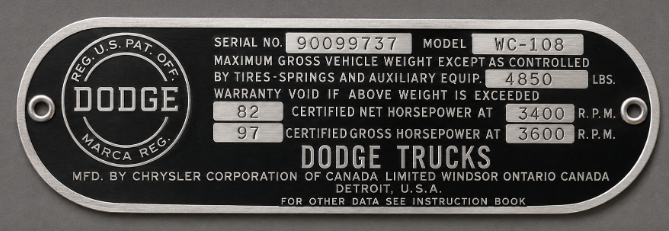
After World War II, Chrysler Corporation resumed civilian vehicle production for the 1946 model year. During this period, Chrysler, Dodge, Plymouth, and DeSoto vehicles did not use a modern Vehicle Identification Number. Instead, they used manufacturer-assigned serial numbers that identified the vehicle series and production sequence.
Unlike later VIN systems, these serial numbers were not standardized across all Chrysler divisions. The format varied by make, model, and year.
Serial number plates were commonly located on:
Most Mopar vehicles built between 1946 and 1954 used a serial number consisting of:
Series Code + Sequential Production Number
Example:
1501-12345
In this example:
The exact meaning of the series code depended on the manufacturer and model year.
There was no universal digit count used across all Chrysler Corporation brands during this period.
Typical serial numbers ranged from approximately:
| Manufacturer | Typical Format |
|---|---|
| Plymouth | 4-digit series code plus sequential production number |
| Dodge | Series prefix plus 4 to 6 digit production number |
| DeSoto | Series designation plus production sequence |
| Chrysler | Series designation plus production sequence |
Total serial number length typically ranged from approximately 8 to 12 characters depending on model and production year.
For most 1946-1954 Mopars, the serial number can usually identify:
The serial number can identify whether the vehicle was built as a:
The prefix or series designation identifies the specific model family.
Examples include:
The numerical portion identifies the vehicle's position within the production run for that series.
A typical 1949 Plymouth serial number may appear similar to:
1501-23456
Where:
Unlike later VIN systems, the digits themselves do not individually identify body style, engine, assembly plant, or trim level.
Because early Mopar serial numbers contained limited information, restorers often rely on additional identification sources.
Many 1946-1954 Mopars carried engine numbers that can help verify originality.
Body tags may provide information about:
Factory production records and historical registries often provide additional information not contained within the serial number itself.
The modern VIN concept did not fully evolve until the 1960s and was not federally standardized until 1981.
For this reason, 1946-1954 Mopar serial numbers should be viewed primarily as identification numbers rather than comprehensive vehicle specification codes.
For enthusiasts restoring early Chrysler, Dodge, Plymouth, and DeSoto vehicles, decoding usually requires examining the serial number, engine number, body tags, and factory documentation together.
Mopar VIN decoding from 1955 to 1965 can be confusing because Chrysler Corporation did not use one single format across the entire period. The mid-1950s still relied heavily on serial number ranges, while 1959 through 1965 used a more structured 10-character VIN format on most U.S. passenger cars.
For that reason, the best way to decode a 1955-1965 Mopar VIN is to first identify the model year range, then apply the correct format.
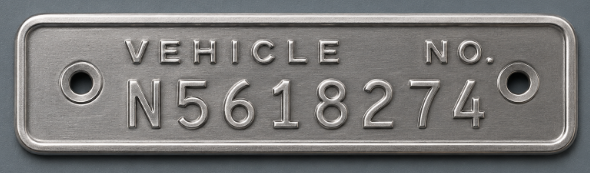
Most 1955-1958 Chrysler, Dodge, Plymouth, DeSoto, and Imperial vehicles used serial-style identification numbers rather than fully decoded VINs like later muscle cars.
These numbers were generally used to identify:
Unlike later VINs, each individual digit did not always decode into a specific item such as engine, body style, or assembly plant.
For many 1955-1958 Mopar passenger cars, the vehicle identification number was commonly an 8-digit serial number. Some body tags and related identification plates may include additional codes, but the main vehicle serial number was usually shorter than later 10-character and 13-character VINs.
For this period, decoding is usually done by comparing the serial number against factory serial number ranges for the specific make, model, and year.
A typical 1955-1958 decoding process looks like this:
A 1955-1958 Mopar serial number can usually help identify the vehicle's basic production identity, but it may not directly provide every option or drivetrain detail.
It can often help confirm:
It may not directly identify:
For those details, use the body tag, engine number, build records, or factory documentation.
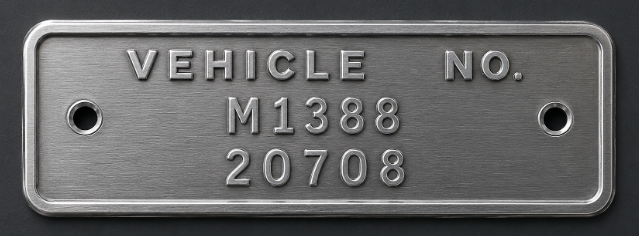
For 1959, Mopar passenger cars commonly used a 10-character VIN format:
Each character group breaks down as follows:
The first character identifies the model year.
For 1959:
Because different references may present 1959 coding differently, always verify with a year-specific Mopar VIN chart.
The second character identifies the car line or division.
This may indicate whether the vehicle is a Plymouth, Dodge, DeSoto, Chrysler, or Imperial.
The third character identifies the price class or trim level.
This may separate lower trim vehicles from higher trim or premium models.
The fourth character identifies the assembly plant.
The final six digits are the sequential production number.
This number identifies the vehicle's place in the production run.
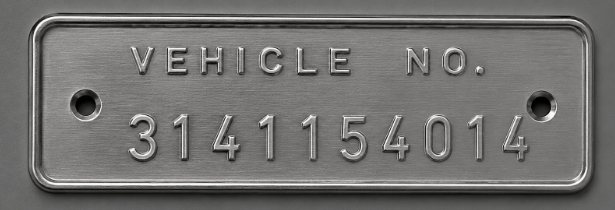
Most U.S. built 1960-1965 Mopar passenger cars use a 10-character VIN format:
This format is one of the most important systems for Mopar owners to understand before the more familiar 1966-up VIN format arrived.
The 1960-1965 VIN breaks down like this:
The first character identifies the car line. This is the starting point for decoding 1960-1965 Mopar VIN numbers.
Examples may include codes for:
The exact meaning of the first character can vary by model year, so it is important to use a year-specific chart when decoding this position.
For 1965, common first character examples include:
The second character identifies the model series, price class, or body type depending on the year and vehicle line.
This position may indicate whether the vehicle was a base model, mid-level trim, premium trim, police package, taxi package, or fleet vehicle.
For 1965, common second character examples include:
Because Chrysler reused some numeric codes differently across car lines, this digit should be decoded together with the first character.
The third character identifies the model year for most 1960-1965 Mopar passenger car VINs.
Examples include:
This is one of the easiest positions to decode in the 1960-1965 VIN format.
The fourth character identifies the assembly plant.
Common 1962-1965 plant code examples include:
Plant codes can vary slightly by year and source, so always verify with a year-specific reference when authenticity matters.
The final six digits are the production sequence number.
This number identifies the vehicle's place in the production run. It does not usually decode options, engine size, paint color, or trim by itself.
For example, in the VIN:
The final six digits are:
That number is the vehicle's production sequence.
Using the 1960-1965 Mopar VIN format:
V identifies a Plymouth Valiant or Barracuda V8 for 1965.
The second digit identifies the vehicle's series or class. Depending on the year-specific chart, this may indicate a special model, taxi, police, or other class designation.
5 identifies the vehicle as a 1965 model.
2 identifies Hamtramck, Michigan.
The last six digits identify the vehicle's production sequence number.
Even though 1959-1965 VINs are more detailed than earlier serial numbers, they still do not provide as much information as later muscle car VINs.
A 1959-1965 Mopar VIN may not fully identify:
For those details, use the body tag, fender tag, broadcast sheet, engine stamping, and factory documentation.
Some Canadian-built Mopar vehicles used slightly different VIN formats. In some cases, Canadian 1965 cars may include an additional C in the VIN, creating an 11-character format instead of the standard 10-character U.S. format.
When decoding Canadian-built Mopars, always use Canadian-specific reference material.
To accurately decode a Mopar VIN from this era, follow this process:
Accurate VIN decoding helps confirm whether a Mopar vehicle is what it is claimed to be. This is especially important for collectible models such as early Barracudas, Chrysler 300 letter cars, Dodge Darts, Plymouth Furys, and early B-body performance cars.
For restoration work, the VIN is only the first step. Matching the VIN with body tags, engine numbers, and documentation provides the most complete picture of the vehicle's original identity.
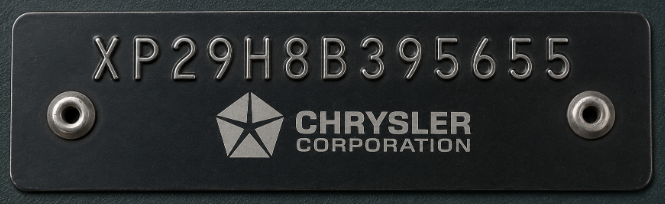
The 1966 through 1970 model years represent the heart of the Mopar muscle car era. During this period, Chrysler Corporation introduced a much more structured VIN system that provided significantly more information than previous identification formats.
Popular vehicles from this era include:
Unlike earlier serial numbers, nearly every position in the VIN serves a specific purpose. By decoding each character, owners can often determine exactly what the vehicle was when it left the factory.
Most 1966-1970 Mopar passenger cars use a 13-character VIN format:
XS29L9B123456
This VIN can be broken into six sections:
| Position | Example | Meaning |
|---|---|---|
| 1 | X | Car Line |
| 2 | S | Price Class |
| 3-4 | 29 | Body Style |
| 5 | L | Engine |
| 6 | 9 | Model Year |
| 7 | B | Assembly Plant |
| 8-13 | 123456 | Production Sequence |
Let's decode each position individually.
The first character identifies the vehicle family or platform.
| Code | Vehicle Line |
|---|---|
| A | Dodge Dart |
| B | Plymouth Barracuda (1966-1969) |
| C | Chrysler Newport |
| E | Chrysler New Yorker |
| F | Dodge Polara |
| G | Plymouth Fury |
| H | Dodge Monaco |
| J | Chrysler 300 |
| L | Dodge Dart Swinger |
| P | Plymouth Fury VIP |
| R | Plymouth Belvedere/Satellite/Road Runner/GTX |
| V | Plymouth Valiant |
| W | Dodge Coronet/Super Bee |
| X | Dodge Charger |
| Y | Imperial |
XS29L9B123456
The "X" indicates the vehicle is a Dodge Charger.
The second character identifies trim level, price class, or performance designation.
| Code | Description |
|---|---|
| L | Low Price Class |
| M | Medium Price Class |
| P | Premium Price Class |
| S | Special Price Class |
| X | High Performance Price Class |
"S" indicates a Special Price Class Charger.
"M" indicates a medium-price Plymouth Belvedere series vehicle.
"S" identifies a Road Runner.
The third and fourth positions identify the body configuration.
| Code | Body Style |
|---|---|
| 21 | Sedan |
| 23 | 2-Door Hardtop |
| 27 | Convertible |
| 29 | Sports Hardtop |
| 41 | Station Wagon |
| 45 | Wagon Variant |
Two-door hardtop.
Convertible.
Sports hardtop, commonly seen on Chargers and other performance models.
XS29L9B123456
The "29" identifies a Charger Sports Hardtop.
The fifth position is often the most important character in a classic Mopar VIN.
This code identifies the engine originally installed at the factory.
| Code | Engine |
|---|---|
| A | 170 Slant Six |
| C | 225 Slant Six |
| D | 273 V8 |
| E | 318 V8 |
| F | 318 2-Barrel |
| G | 383 2-Barrel |
| H | 383 4-Barrel |
| J | 426 HEMI |
| K | 440 4-Barrel |
| L | 440 High Performance |
| M | 440 Six Barrel/Six Pack |
| N | 383 High Performance |
| P | 340 High Performance |
| R | 440 Magnum (certain applications) |
Engine codes vary slightly by year and model line.
Always verify engine codes using year-specific factory references.
XS29L9B123456
The "L" identifies a factory 440 High Performance engine.
The sixth character identifies the model year.
| Code | Year |
|---|---|
| 6 | 1966 |
| 7 | 1967 |
| 8 | 1968 |
| 9 | 1969 |
| 0 | 1970 |
XS29L9B123456
The "9" indicates a 1969 model year.
The seventh position identifies where the vehicle was built.
| Code | Plant |
|---|---|
| A | Lynch Road, Michigan |
| B | Hamtramck, Michigan |
| C | Jefferson, Michigan |
| D | Belvidere, Illinois |
| E | Los Angeles, California |
| F | Newark, Delaware |
| G | St. Louis, Missouri |
XS29L9B123456
The "B" identifies Hamtramck Assembly.
Many HEMI and high-performance Mopars were assembled at Hamtramck.
The final six digits represent the vehicle's unique production sequence.
XS29L9B123456
The production sequence is:
123456
These numbers do not identify options, engine upgrades, colors, or transmission type.
They simply identify the vehicle's position within the production run.
Let's decode the full VIN:
| Position | Value | Meaning |
|---|---|---|
| 1 | X | Dodge Charger |
| 2 | S | Special Price Class |
| 3-4 | 29 | Sports Hardtop |
| 5 | L | 440 High Performance |
| 6 | 9 | 1969 |
| 7 | B | Hamtramck Assembly |
| 8-13 | 123456 | Production Sequence |
This VIN identifies a:
1969 Dodge Charger Special Price Class Sports Hardtop originally equipped with a 440 High Performance engine and built at the Hamtramck Assembly Plant.
Even though 1966-1970 VINs provide much more information than earlier Mopar identification systems, they do not reveal everything.
The VIN alone typically cannot identify:
For those details, you must inspect the vehicle's:
The fender tag contains factory option codes and production information.
The broadcast sheet is the original factory build document and is one of the most valuable sources of information for restorers.
Matching numbers collectors often use these stampings to verify originality and authenticity.
Because vehicles equipped with the 426 HEMI and 440 Six Pack are among the most valuable Mopars ever produced, VIN verification is especially important.
A genuine HEMI or Six Pack car should have:
Proper VIN decoding is often the first step in confirming the authenticity of these highly collectible muscle cars.
Sign up now to join the JEGS email newsletter and be the first to learn about new products, special deals and e-mail only offers!
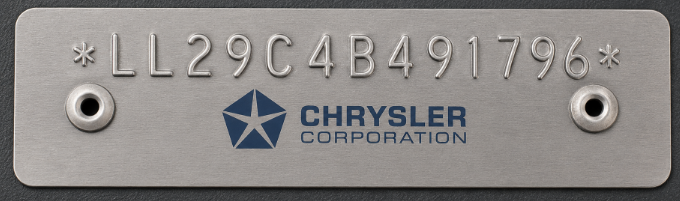
Beginning in 1971, Chrysler Corporation revised its VIN system to provide more detailed vehicle information. While the basic structure remained similar to the late 1960s format, additional vehicle classifications were incorporated to support growing federal safety, emissions, and manufacturing requirements.
This VIN system was used across many popular Mopar vehicles including:
For most passenger cars, the VIN remained a 13-character format that could identify the vehicle line, price class, body style, engine, model year, assembly plant, and production sequence.
BS23R1B123456
This VIN can be broken into the following sections:
| Position | Example | Meaning |
|---|---|---|
| 1 | B | Car Line |
| 2 | S | Price Class |
| 3-4 | 23 | Body Style |
| 5 | R | Engine |
| 6 | 1 | Model Year |
| 7 | B | Assembly Plant |
| 8-13 | 123456 | Production Sequence |
The first character identifies the vehicle family.
| Code | Vehicle |
|---|---|
| A | Dodge Dart |
| B | Plymouth Barracuda |
| C | Chrysler Newport |
| D | Dodge Dart Sport |
| E | Chrysler New Yorker |
| F | Dodge Aspen |
| G | Plymouth Fury |
| H | Chrysler Cordoba |
| J | Chrysler 300 |
| L | Dodge Dart Swinger |
| M | Dodge Monaco |
| P | Plymouth Fury |
| R | Plymouth Satellite |
| V | Plymouth Valiant |
| W | Dodge Coronet |
| X | Dodge Charger |
| Y | Imperial |
Some vehicle line codes changed slightly throughout the decade, particularly after the introduction of newer platforms such as the Aspen and Volaré.
The second position identifies trim level or price class.
| Code | Description |
|---|---|
| L | Low Price Class |
| M | Medium Price Class |
| P | Premium |
| S | Special |
| X | Performance or Special Performance |
The exact meaning depends on the specific model line.
For example, an "S" on a Challenger may indicate a different trim level than an "S" on a Satellite.
The third and fourth characters identify body style.
| Code | Body Style |
|---|---|
| 21 | Sedan |
| 23 | Hardtop Coupe |
| 27 | Convertible |
| 29 | Sports Hardtop |
| 41 | Station Wagon |
| 45 | Custom Wagon |
| 67 | Fastback |
| 95 | Pickup Truck |
BS23R1B123456
The "23" identifies a two-door hardtop.
The engine code remains one of the most important positions in the VIN.
This character identifies the engine originally installed by Chrysler.
| Code | Engine |
|---|---|
| G | 318 V8 |
| H | 340 V8 |
| J | 360 V8 |
| L | 440 Four Barrel |
| N | 383 Four Barrel |
| P | 340 Six Pack |
| R | 426 HEMI |
| U | 440 Six Pack |
| C | 225 Slant Six |
As emissions regulations increased, engine offerings changed.
Common engine codes may include:
| Code | Engine |
|---|---|
| C | 225 Slant Six |
| E | 318 V8 |
| F | 360 V8 |
| G | 400 V8 |
| H | 440 V8 |
Always reference year-specific Mopar documentation when verifying engine codes because Chrysler occasionally reassigned letters.
The sixth character identifies the model year.
| Code | Year |
|---|---|
| 1 | 1971 |
| 2 | 1972 |
| 3 | 1973 |
| 4 | 1974 |
| 5 | 1975 |
| 6 | 1976 |
| 7 | 1977 |
| 8 | 1978 |
| 9 | 1979 |
| A | 1980 |
BS23R1B123456
The "1" indicates a 1971 model year.
The seventh position identifies where the vehicle was assembled.
| Code | Assembly Plant |
|---|---|
| A | Lynch Road, Michigan |
| B | Hamtramck, Michigan |
| D | Belvidere, Illinois |
| E | Los Angeles, California |
| G | St. Louis, Missouri |
| H | Newark, Delaware |
| M | Windsor, Ontario |
| R | Windsor Assembly |
| S | Jefferson Assembly |
BS23R1B123456
The "B" identifies the Hamtramck Assembly Plant.
The final six digits identify the vehicle's production sequence.
BS23R1B123456
Production number:
123456
These numbers indicate where the vehicle fell in the production run.
They do not identify:
BS23R1B123456
| Character | Meaning |
|---|---|
| B | Plymouth Barracuda |
| S | Special Price Class |
| 23 | Hardtop Coupe |
| R | 426 HEMI |
| 1 | 1971 |
| B | Hamtramck Assembly |
| 123456 | Production Sequence |
This VIN identifies a 1971 Plymouth Barracuda Special Price Class hardtop originally equipped with a 426 HEMI engine and assembled at the Hamtramck plant.
Early 1970s E-Body vehicles remain some of the most valuable Mopars ever built. VIN verification is extremely important when evaluating these cars.
Introduced in the mid-1970s, these models use the same general VIN structure but different car line codes and engine designations.
Truck VINs follow a somewhat different structure than passenger cars. Truck VINs often incorporate:
For truck restorations, factory truck VIN charts should be consulted.
Even though 1971-1980 VINs contain more information than earlier systems, they still cannot fully identify:
For those details, Mopar owners should inspect:
The fender tag remains one of the most important identification tools on classic Mopars.
Broadcast sheets provide the complete factory build information.
These stampings help confirm matching-numbers authenticity.
The 1971-1980 VIN system represents the bridge between classic muscle car VINs and the fully standardized 17-character VIN system introduced across the automotive industry in 1981.
For Mopar enthusiasts, understanding this era is essential because it covers everything from the final years of the HEMI muscle car era to the introduction of iconic vehicles such as the Dodge Aspen, Plymouth Volaré, and later Dodge trucks that helped shape Chrysler's future.
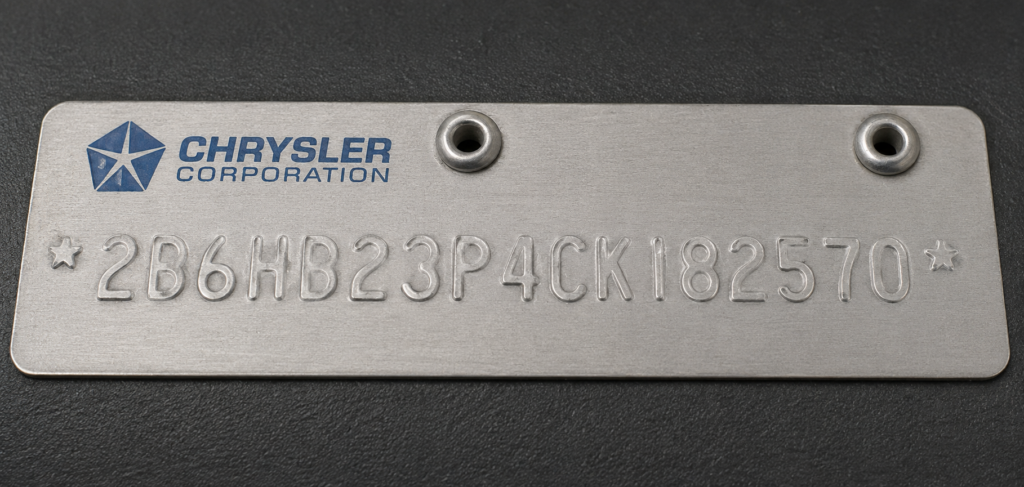
Beginning with the 1981 model year, all vehicles sold in the United States adopted a standardized 17-character Vehicle Identification Number system. This format was mandated by the National Highway Traffic Safety Administration (NHTSA) to improve vehicle identification, safety tracking, theft prevention, recalls, and registration accuracy.
Unlike earlier Mopar VIN systems, every position within the VIN has a specific purpose and follows a standardized structure.
This format applies to:
Popular examples include:
2C3CDXCT0NH123456
The VIN is divided into three primary sections:
| VIN Position | Description |
|---|---|
| 1-3 | World Manufacturer Identifier (WMI) |
| 4-8 | Vehicle Description Section (VDS) |
| 9 | Check Digit |
| 10 | Model Year |
| 11 | Assembly Plant |
| 12-17 | Production Sequence Number |
Let's decode each section.
The first three characters identify the manufacturer and country of origin.
| WMI | Manufacturer |
|---|---|
| 1B3 | Dodge USA |
| 1C3 | Chrysler USA |
| 1D3 | Dodge Truck USA |
| 1J4 | Jeep USA |
| 2B3 | Dodge Canada |
| 2C3 | Chrysler Canada |
| 2D3 | Dodge Truck Canada |
| 2J4 | Jeep Canada |
| 3C3 | Chrysler Mexico |
| 3D7 | Dodge Truck Mexico |
| 3C6 | Ram Mexico |
| 1C6 | Ram USA |
2C3CDXCT0NH123456
The first three characters:
2C3
Identify a Chrysler Corporation passenger vehicle manufactured in Canada.
The next five positions provide detailed information about the vehicle.
These characters may identify:
Unlike earlier VIN eras, these positions vary significantly by model and year.
2C3CDXCT0NH123456
Characters 4-8:
CDXCT
May identify:
Because Chrysler updates these codes regularly, they must be interpreted using year-specific decoding charts.
The ninth character is the check digit.
The check digit is not used to identify vehicle features.
Instead, it is mathematically calculated from the other VIN positions and helps verify that the VIN is valid.
Examples may include:
2C3CDXCT0NH123456
The ninth character is:
0
This is the VIN's validation digit.
The tenth character identifies the model year.
| Code | Year |
|---|---|
| B | 1981 |
| C | 1982 |
| D | 1983 |
| E | 1984 |
| F | 1985 |
| G | 1986 |
| H | 1987 |
| J | 1988 |
| K | 1989 |
| L | 1990 |
| M | 1991 |
| N | 1992 |
| P | 1993 |
| R | 1994 |
| S | 1995 |
| T | 1996 |
| V | 1997 |
| W | 1998 |
| X | 1999 |
| Y | 2000 |
| 1 | 2001 |
| 2 | 2002 |
| 3 | 2003 |
| 4 | 2004 |
| 5 | 2005 |
| 6 | 2006 |
| 7 | 2007 |
| 8 | 2008 |
| 9 | 2009 |
| A | 2010 |
| B | 2011 |
| C | 2012 |
| D | 2013 |
| E | 2014 |
| F | 2015 |
| G | 2016 |
| H | 2017 |
| J | 2018 |
| K | 2019 |
| L | 2020 |
| M | 2021 |
| N | 2022 |
| P | 2023 |
| R | 2024 |
| S | 2025 |
2C3CDXCT0NH123456
The tenth character:
N
Identifies a 2022 model year vehicle.
The eleventh character identifies where the vehicle was assembled.
| Code | Plant |
|---|---|
| A | Auburn Hills, Michigan |
| B | Brampton, Ontario |
| C | Jefferson North, Michigan |
| D | Belvidere, Illinois |
| E | Saltillo, Mexico |
| G | Sterling Heights, Michigan |
| H | Windsor, Ontario |
| R | Windsor Assembly |
| S | Warren Truck Assembly |
| T | Toluca, Mexico |
2C3CDXCT0NH123456
The eleventh character:
H
Identifies Windsor Assembly in Ontario, Canada.
The final six digits represent the vehicle's unique serial number.
2C3CDXCT0NH123456
The final six digits:
123456
Identify the specific vehicle built during production.
No two vehicles from the same model year and plant will share the same sequence number.
2C3CDXCT0NH123456
| Position | Meaning |
|---|---|
| 2C3 | Chrysler Canada |
| CDXCT | Vehicle Description Section |
| 0 | Check Digit |
| N | 2022 Model Year |
| H | Windsor Assembly |
| 123456 | Production Sequence |
This VIN identifies a Chrysler Corporation vehicle manufactured in Canada, built for the 2022 model year at the Windsor Assembly Plant.
Many readers specifically search for Challenger VIN decoding.
2C3CDZBT6PH123456
Potential information may include:
Modern Challengers, Chargers, and SRT vehicles often use VDS codes that identify engines ranging from the Pentastar V6 to the supercharged Hellcat and Demon platforms.
Ram trucks use the same 17-character VIN structure but often include additional information within positions 4-8.
These positions may identify:
This makes VIN decoding especially useful when purchasing used trucks.
Jeep VINs can reveal:
Because many Jeep models share similar appearances, VIN decoding is often the easiest way to verify original equipment.
Even though modern VINs contain more information than any previous Mopar VIN system, they still do not reveal everything.
The VIN typically does not identify:
For those details, consult:
Whether you're purchasing a used Challenger, verifying a HEMI-powered Ram truck, researching a Jeep Wrangler, or restoring an early Viper, understanding the 17-character VIN allows you to quickly verify the vehicle's identity and factory specifications.
Because this VIN format remains in use today, learning to decode it provides the foundation for understanding virtually every Chrysler, Dodge, Jeep, and Ram vehicle built from 1981 onward.
The VIN location varies depending on the vehicle's production year.
Early Mopar vehicles often display the serial number or VIN on:
Most muscle car era Mopars have the VIN located:
Additional VIN stampings may also appear on:
Modern Mopar vehicles typically display the VIN:
Checking multiple VIN locations helps verify vehicle authenticity.
A matching numbers Mopar is a vehicle that retains the major components installed at the factory when it was originally built.
For many collectors, this typically means:
Matching numbers vehicles are often more valuable because they verify originality.
This is especially important for highly collectible Mopars such as:
Verification may involve comparing:
For rare muscle cars, matching numbers documentation can have a significant impact on collector value.
From the serial numbers used on postwar Chrysler, Dodge, Plymouth, and DeSoto vehicles to the modern 17-character VIN system used today, Mopar vehicle identification has evolved significantly over the decades.
Understanding how to decode a Mopar VIN can help verify a vehicle's authenticity, identify its original specifications, support restoration projects, and uncover valuable information about its production history. Whether you're researching a classic muscle car, evaluating a project vehicle, or verifying a modern Mopar, the VIN is one of the most important tools available.
Whether you're restoring a matching numbers Mopar muscle car, upgrading a classic Dodge truck, or building a modern HEMI-powered project, understanding your vehicle's VIN is often the first step toward selecting the correct parts and components.
At www.jegs.com, you'll find restoration parts, performance upgrades, engine components, ignition systems, fuel system parts, suspension upgrades, wheels, tires, and drivetrain components from trusted manufacturers including Holley, Edelbrock, MSD Ignition, COMP Cams, Flowmaster, and many more.
If you need help finding parts for your Mopar project, the JEGS Tech Specialists can help you identify the right components based on your vehicle's year, model, engine, and intended use.



Leave a Reply