Sign up now to join the JEGS email newsletter and be the first to learn about new products, special deals and e-mail only offers!

 50 People Found This Article Helpful


Holley carburetors are the thorn in the side of electronic fuel injection systems for classic cars, hot rods, and restomods. That’s because while add-on EFI systems are plug-and-play, set-and-forget things, nothing beats the sheer capability of a Holley carb. So, if you don’t give up easily, a Holley on your engine will spice things up.
But they aren’t as hard to set up and get running as popularly believed. Many of those who talk trash about carbs are those who prefer their fuel to be spoon-fed. So let us help you pick your carb of choice by comparing two popular Holley models – the 4150 and the 4160. We’ll tell you the difference between 4150 and 4160 Holley carburetors. This will help you pick the best Holley carburetor for your car.
Note that these aren’t the only Holley carburetors around. This renowned brand has several more carburetors for every requirement. So, if you want something else, talk to our team at JEGS. They’ll gladly help you find the right carburetor for your engine, performance needs, and driving scenarios.
A carburetor is an essential component in older internal combustion engines, responsible for mixing air and fuel to create the perfect combustion ratio. At its core, the carburetor functions on Bernoulli's principle, which states that an increase in the speed of a fluid occurs simultaneously with a decrease in pressure. When you press the accelerator, it opens a valve, allowing more air to flow through the carburetor. This air flows through a narrow section called the venturi, where its speed increases and pressure decreases. This pressure drop creates a vacuum that draws fuel from the float chamber into the airstream through small nozzles known as jets.
As the air and fuel mix, they form an atomized mixture that enters the engine's cylinders for combustion. The carburetor also includes a throttle plate to control the amount of this mixture that enters the engine, regulating the engine's power and speed. Additionally, it has various adjustments and circuits to fine-tune the mixture under different operating conditions, such as idle, acceleration, and cruising. Despite being largely replaced by modern fuel injection systems, carburetors remain a popular choice among classic car enthusiasts and in motorsports for their simplicity and ease of tuning.

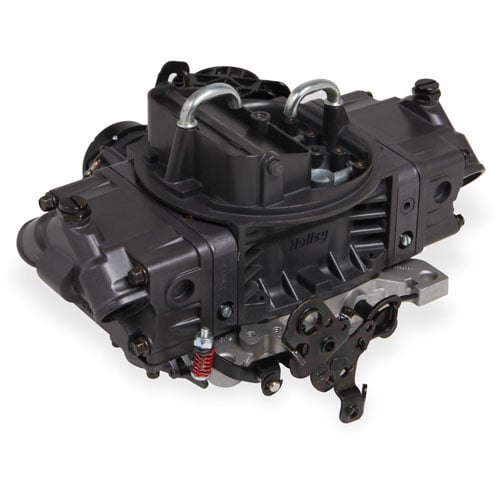
The Holley 4150 and 4160 are four-barrel carburetors. They use a standard, square-flange Holley pattern and are available in various flow rates from various Holley performance categories, including the Holley Classic Carburetor, Holley Street Avenger Carburetor, and Holley Street Warrior Carburetor categories.
The Holley 4150 carburetor design features a metering block in the primary and secondary ends. Thus, the carburetor is notably longer than a Holley 4160 or other types that do not have two distinctive metering blocks. As we shall explain later in this article, this makes the Holley 4150 excellent for tuning.
The Holley 4160 has a primary metering block and a thinner secondary metering plate. The rear float bowl typically covers this. Hence, the carburetor is shorter than a Holley 4150. The quickest way to differentiate a 4150 from a 4160 is the transfer tube seen connecting the bowls on the 4160. However, not all 4160s have the transfer tube, so the next visual difference is with the metering block and plate differences.

Sign up now to join the JEGS email newsletter and be the first to learn about new products, special deals and e-mail only offers!
Choosing the right carburetor for your ride can seem like rocket science. However, it’s a lot simpler. You can talk to our team, who will guide you in the right direction. You can also check out online resources, such as those provided by Holley. Here are some tips to get you pointed in the right direction.
First, what’s your main priority? Is it fuel economy, performance, or a bit of both? You can’t have the best of both, so if you need a blend, there’s got to be a compromise. That’s why you’ll find carburetors for street use and track and drag use. The latter two prioritize performance at the expense of fuel economy. Meanwhile, street carburetors are designed to provide a sort of middle ground.
On the topic of performance, it’s not uncommon for highly-tuned cars to use E85 or Methanol. Holley has carburetors that can accept this, so if you’re planning a build incorporating these fuels, it’s critical to have the right carburetor under the hood, which leads us to our next point.


When deciding between a two-barrel and a four-barrel carburetor, it's crucial to consider your vehicle's performance needs and driving habits. A two-barrel carburetor, often found in economy and everyday vehicles, has two small throttle bores that provide a balanced mix of air and fuel, making it ideal for low to moderate engine speeds. This setup offers better fuel efficiency and is typically easier to tune and maintain, making it suitable for daily driving and light-duty applications.
On the other hand, a four-barrel carburetor, common in high-performance and racing vehicles, features two primary and two secondary throttle bores. The primary bores handle normal driving conditions, while the secondary bores open up under heavy acceleration or high engine loads, delivering a significant boost in power and performance. This design allows for a more precise fuel-air mixture at higher speeds, making it the preferred choice for those seeking increased horsepower and improved throttle response. However, a four-barrel carburetor can be more complex to tune and may lead to higher fuel consumption. Ultimately, your choice depends on whether you prioritize fuel efficiency and simplicity (two-barrel) or enhanced performance and power (four-barrel).
Yes, you can find carburetors optimized for off-road applications. In addition, there are marine-specific applications as well. So, if you’re building an off-roader with a very strong V8 or even a V8-powered boat, we can help you pick the best carburetor.

Did you know that Holley has covered you if you’re concerned with emissions compliance? They make some emissions-compliant carburetors that will perform better than the factory units they intend to replace. So, if this is a requirement, we can help you pick the right emissions-compliant carburetor.
When comparing the Holley 4150 and Holley 4160 carburetors, the primary distinction lies in their tunability and simplicity. The Holley 4150 is renowned for its high degree of tunability, making it a favorite among performance enthusiasts. It features dual metering blocks, which provide separate fuel circuits for the primary and secondary barrels, allowing for precise adjustments to fuel delivery. This configuration is particularly beneficial for fine-tuning the air-fuel ratio across different engine loads and RPM ranges, making the 4150 ideal for racing and high-performance applications where optimal performance is critical.
In contrast, the Holley 4160 is designed with simplicity in mind. It utilizes a single metering block for the primary barrels and a metering plate for the secondary barrels, which simplifies the overall design and reduces the number of adjustable components. This makes the 4160 easier to install and maintain, making it a popular choice for street vehicles and those who prefer a set-and-forget approach. While the 4160 may not offer the same level of fine-tuning as the 4150, it provides reliable performance with less hassle, appealing to those who value ease of use over the ability to make extensive adjustments. Ultimately, the choice between the Holley 4150 and 4160 comes down to whether you prioritize tunability and performance (4150) or simplicity and ease of maintenance (4160).

Whether it’s a Holley carb you’re after or something else, we’ve got it right here at JEGS. In fact, with thousands of products covering every conceivable auto part, you’ll be in car or truck nirvana. If you’re a bit star-struck by what we offer, our team will gladly guide you in the right direction.

I am looking for a rebuild kit for a Holley 4 bbl. carb. It has a list number of 6506 variant 344. This unit goes on a 1970 Model Ford 390cid engine and it is fitted with a governor on the throttle. Do you have such a kit or can you give me a P/N to find it?
thanks,
Larry

Larry, the list number 6506 identifies your carb as an older Holley 4150 series unit that was commonly used on Ford 390 applications, especially in truck or industrial setups where a governor was used. Since it is a 4150 style carb, the good news is that rebuild support is still widely available. When it comes to rebuild kits, you do not need to match the exact list number as much as you need to match the carb family and gasket configuration. Most standard Holley 4150 rebuild kits from Holley or brands like Quick Fuel will service that carb as long as it is still in its original configuration. The governor setup on the throttle side does not usually change the internal fuel circuits, so it typically does not affect the rebuild kit choice. What you will want to do is confirm whether your carb has the traditional metering blocks on both the primary and secondary sides, which is standard for a 4150, and then choose a kit that matches that layout. If any parts have been changed over the years, like metering blocks or fuel bowls, that could affect which kit is the best match, so that is something to keep in mind. If you want to be completely certain before ordering, having a quick look at the gasket layout or sending a picture can help confirm the correct kit. If you would like help making sure you get the right rebuild kit for your exact carb, give us a call at 1-800-345-4545 and speak with a Tech Specialist and we will be glad to help.

Just curious. I have a 4160 with dual metering blocks, but a single pump. This is designated as a 4160G in a 1975 drawing. What is the benefit of adjusting screws on the non-pumping secondary side?
Great question. Your 4160 carb with dual metering blocks but a single accelerator pump is a bit of a hybrid setup. The “4160G” designation in older documentation sometimes refers to variations that blur the typical 4150/4160 line, especially in factory or emissions-era configurations.
Normally, a Holley 4160 comes with a primary metering block and a secondary metering plate, which is non-adjustable. However, when a 4160 has been fitted with dual metering blocks, you now have the ability to tune both the primary and secondary fuel circuits independently, just like a 4150.
Even though there’s no accelerator pump on the secondary side, the idle mixture screws on the secondary metering block (if present) allow you to fine-tune fuel delivery at idle and just off-idle, particularly if you’re running a carb on a dual-plane intake or have a more aggressive camshaft. These screws can help balance the idle mixture across all four barrels, especially in engines with poor vacuum at idle or inconsistent fuel distribution.
So the benefit is more precise control, especially during idle and transition off-idle, even though fuel is not being squirted into the secondaries like it is on the primaries. It’s a nice feature to have when tuning for crisp throttle response and smooth drivability.
If you need additional help, contact us at 1-800-345-4545 and speak to a tech support specialist.

Hi, I’m looking to replace my afb with a holley 4160. Will the 4160 bolt to my stock manifold. I have a 1962 plymouth fury 361 b block. I’m having heat soak causing hard start after 20 minutes when hot. I’m hoping the design of front and rear fuel bowls will alleviate the percolation I’m experiencing with the afb havin fuel bowls in the rear sides
Hi Rodney,
Great question, and you’re on the right track. Since your 1962 Plymouth Fury with a 361 CID B-block originally came with a Carter AFB carburetor, you’ll be glad to know that the Holley 4160 is also a square bore carb, just like the AFB. In most cases, the bolt pattern is close enough that the Holley 4160 will bolt directly to your stock intake manifold without the need for an adapter. It’s always a good idea to double-check bolt hole alignment and throttle linkage clearance, but for most Mopar B-blocks of that era, the swap is straightforward.
As for the heat soak issue and hard starts, yes, switching to the Holley 4160 can help. The 4160 uses center-mounted front and rear fuel bowls, which are typically better isolated from manifold heat compared to the side-mounted fuel bowl design of the AFB. That layout, combined with the option of adding a phenolic spacer, can significantly reduce the chance of fuel percolation and vapor lock after shutoff. If you have the hood clearance, adding a ½” to 1″ phenolic spacer can further insulate the carb from engine heat.
If you need help picking the right spacer or confirming your setup, feel free to give JEGS Tech Support a call at 1-800-345-4545. Hope this helps get your Fury starting strong and running cool!




Leave a Reply