Sign up now to join the JEGS email newsletter and be the first to learn about new products, special deals and e-mail only offers!

 71 People Found This Article Helpful
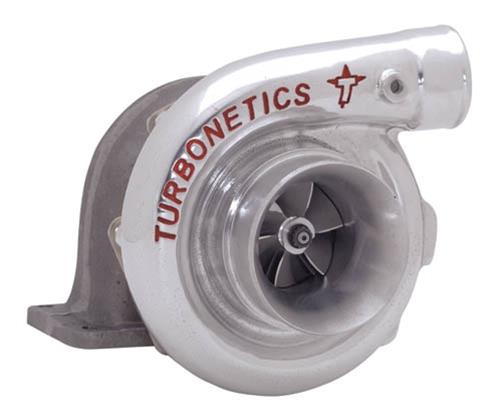

Even though turbocharging sounds extremely difficult and complicated, it isn't all that bad. A turbocharger makes your car more powerful than a naturally aspirated engine of the same capacity, and that’s what you’re after when exploring turbo kits.
Although this article won't explain how to turbocharge your specific vehicle, it will explain what turbocharging is, how it works, and what a basic turbo kit looks like if you're looking to purchase one. If you’ve ever wondered how a turbo works, this article is for you.
Naturally aspirated engines suck in air at atmospheric pressure, creating a fuel/air mixture that ignites in the cylinders and produces power. Obviously, this setup is somewhat limited since you can only cram so much air into the engine. This is where turbochargers come in.
The turbocharger is a device that looks almost like a snail and is responsible for forcing more air into the engine. This allows the car's computer to add more fuel to the mixture resulting in more power being created. Turbochargers use exhaust gasses to spin a turbine that compresses the intake air.
A lot of people wonder what does a turbocharger do without realizing just how many components are involved in a turbo kit. If you're looking to turbocharge your car, that’s exactly what you’ll need though. Aftermarket turbo kits are usually vehicle specific though some components can obviously be universal.
Most turbo kits include the turbo itself, which consists of the turbine and the compressor, the intercooler which is responsible for cooling the intake air, wastegates, blow-off valves, and the associated piping and manifolds required to install said turbo kit.
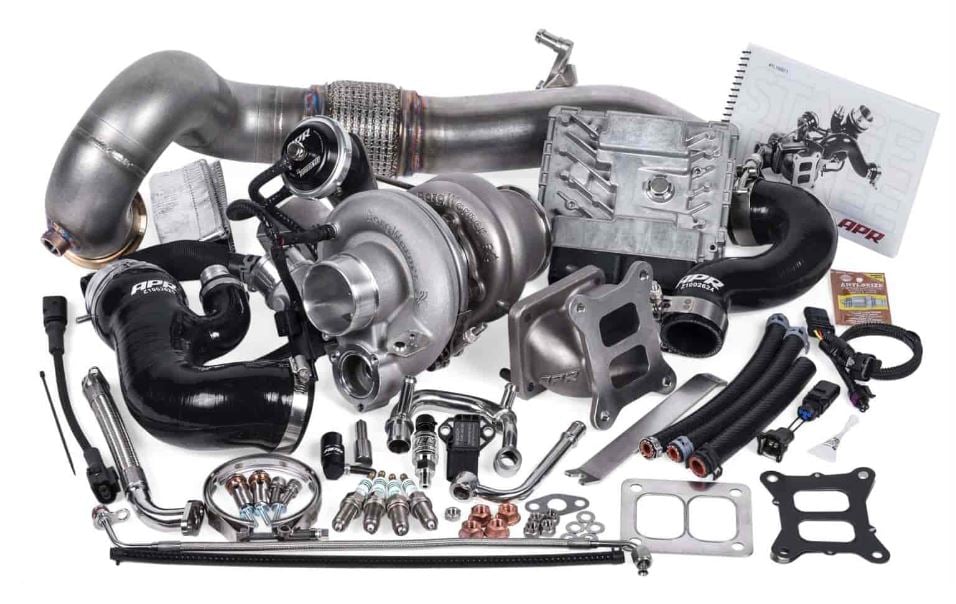
When selecting a turbo kit it's very important to buy one that was designed to fit your vehicle. Although you can purchase just about any turbo kit on the market and make it work, it would require much more custom work as opposed to buying a vehicle-specific turbo kit from the start.
The next thing you'll want to consider is what size of turbo you'll need. The larger the turbo, the more power it'll be able to produce. Larger turbochargers cause greater turbo lag, so they are typically only used when you want to produce an insane amount of power. Larger turbochargers will also raise reliability concerns as well since they’re creating more pressure and compression inside the engine itself.
You also have to consider whether you want a single turbo kit or a twin-turbo kit. Twin-turbo kits are usually more expensive and more complicated to set up, but they result in less turbo lag. You’re also more likely to install a twin-turbocharger setup when you’re working with a V-shaped engine that has two different banks of cylinders.
Sign up now to join the JEGS email newsletter and be the first to learn about new products, special deals and e-mail only offers!
Fitting a turbocharger kit to a naturally aspirated engine is a difficult process and one that requires significant mechanical knowledge. If you're not confident when it comes to working on your own car, let alone causing irreversible changes to the engine, then it's best to take your car to a professional mechanic shop and let them do the work.
The turbo setup involves finding a spot for the turbo to sit in, mounting it, fitting the intercooler and associated piping, as well as drilling a hole in the oil pan for the turbocharger to drain its oil into.
Cars that are already turbocharged are much easier to work on since you'll probably only replace the turbocharger with a larger one or fit a much beefier intercooler in place of the factory one.If you're looking for a turbocharger kit for your vehicle, JEGS has you covered. From complete turbocharging kits to gaskets, intercoolers, and individual turbochargers, JEGS has everything you need to make your car perform the way you want it to.

I am considering adding a turbo to my 2009 arcadia. purpose is to increase power and torque for towing my boat. Can you provide a turbo kit for a 3.6 v6 engine and any additional computer controls I may need.
Or should I buy a newer SUV?
any suggestions? I like my rig.

Hello Michael! Enhancing your 2009 GMC Acadia’s towing capabilities by adding a turbocharger is an ambitious project that requires careful consideration. Here’s a breakdown to help you decide:
1. Turbocharging the 3.6L V6 Engine:
The 2009 Acadia is equipped with a 3.6-liter V6 engine (LLT), known for its high compression ratio of over 11:1. This high compression is not ideal for forced induction without significant modifications, such as using high-octane fuel or implementing intercooling systems.
2. Available Turbo Kits:
While turbocharging is possible, there are limited aftermarket turbo kits specifically designed for the 3.6L V6 engine in the Acadia. Most available kits are tailored for other vehicles with similar engines, like the Chevrolet Camaro. For instance, Edelbrock offers a supercharger kit for the 3.6L V6, but its compatibility with the Acadia is uncertain.
3. Additional Considerations:
Engine and Transmission Durability: The Acadia’s engine and transmission are not designed to handle the increased power and torque from forced induction. Upgrading these components would be necessary to ensure reliability.
Fuel and Tuning: To accommodate the turbo, you’ll need to upgrade the fuel system and have the engine professionally tuned to manage the increased air and fuel flow.
Cost and Complexity: The total cost for such modifications can be substantial, and the complexity of the installation requires expertise.
4. Alternative Solutions:
Given the challenges and costs associated with turbocharging your Acadia, you might consider the following alternatives:
Performance Tuning: Optimizing the existing engine through performance tuning can improve power and torque without the need for forced induction.
Upgrading to a Newer Vehicle: Modern SUVs are designed with higher towing capacities and more robust engines. For example, the 2021 GMC Acadia offers a towing capacity of up to 5,000 pounds, depending on the configuration.
5. Recommendations:
-Consult a Professional: Before making any decisions, consult with a performance specialist like a JEGS Tech who can assess your Acadia and provide tailored advice. We are open 7 am-Midnight EST Monday through Friday and 8:00 am-11:00 pm on Saturday and Sunday. Call us at 1-800-345-4545.
-Evaluate Your Needs: Consider how often you tow and the weight of your boat. If towing is a frequent requirement, investing in a vehicle designed for higher towing capacities might be more practical.
While adding a turbo to your 2009 GMC Acadia is possible, it involves significant modifications and costs. Carefully weigh the benefits against the investment and potential challenges before proceeding.

I am interested in putting twin turbos on my 2006 dodge magnum rt Awd. I already have cold air intake. Is this able to be done. I’m not looking for huge gains in hp, maybe just get it to 400hp from 340+ it already has. Also I’m not looking for super expensive. Any suggestions?
Thank you in advance,
Steven, putting twin turbos on your 2006 Dodge Magnum RT AWD is an exciting project! However, most likely your cold air intake will not work as each of the turbos usually has a separate filtered intake pipe. The most expensive parts will be the turbochargers, followed by the manifolds/headers, ECU tune, and then piping. Most likely, with all new parts, you will be investing at least $5,000 to $10,000 when the project is complete.
If you are interested in discussing further, please call us at 1-800-345-4545 and speak to a tech specialist who can help narrow down your options for a custom twin-turbo setup. We are open 7 am-Midnight EST Monday through Friday and 8:00 am-11:00 pm on Saturday and Sunday. Good luck with this project, it will make a big difference and make your Magnum even more fun to drive!




Leave a Reply