
Sign up now to join the JEGS email newsletter and be the first to learn about new products, special deals and e-mail only offers!

 34 People Found This Article Helpful


Just because your engine has a small block doesn't mean it can't produce big power. While you can add headers, improve the exhaust system, and upgrade your intake manifold, bolt-ons will only get you so far. This is where forced induction comes into play. Forced induction systems, like superchargers and turbos, force more air through the engine to help you maximize power.
While turbos can be a great choice (our supercharger vs. turbocharger comparison covers the tradeoffs), superchargers are belt-driven systems that can help you add significant numbers to your total horsepower and torque output. That's why a Chevy 350 supercharger, or SBC supercharger, is one of the most popular power adders for this engine. Read on to learn everything you need to know about supercharging your Chevy 350 small block engine.
We'll cover how much boost a stock 350 can take, roots vs. centrifugal blowers, engine prep, installation, and our top SBC supercharger kit picks.
Supercharging your 5.7-liter 350 small block might initially seem as simple as bolting on the parts. If you want the engine to last longer than a few seconds, you need to supercharge it correctly. This involves choosing the right supercharger, prepping your engine, and ensuring your cooling system can handle the extra heat.
First, we'll start with prepping your engine. If you plan on forcing more power through the engine, you need the right supporting parts. The most crucial factor to consider is heat.
When you supercharge an engine, a lot of heat is created, so it's a good idea to have an intercooler to keep the engine's temperature down if you plan on going above 5-7 PSI. If the engine runs too hot, you can fry your piston rings, blow a head gasket, and damage your internal engine components.
You'll also want to ensure the fuel pump delivers sufficient flow and that you're tuning the engine properly. It's also a good idea to use premium or plus fuel, but you can alter this with the tune. You may also want to upgrade the exhaust and add one of our cold air intake kits to improve airflow further, squeezing just a few more horsepower out.
A supercharged small block Chevy is only as reliable as the parts supporting it. Check these off before the blower goes on.
Once you have your engine prepped, you can begin the shopping process. For the best results, look for superchargers that give you around 5-7 PSI. Anything higher can be too much for a Chevy 350 small block.

Stock Chevy 350 small blocks aren't known for producing crazy high horsepower or torque numbers. While this may be the case, that doesn't mean they can't be tweaked a bit, and adding a forced air induction system is a great way to boost your 350 Chevy small block. As for the maximum horsepower a Chevy 350 can handle, you can push it to about 450.
Once you exceed this number, you may have to upgrade to performance pistons, engine bolts, headers, and other components. If you're heading to the drag strip and reliability isn't a concern, you can squeeze 600 horsepower out of the engine with the right supercharger. Unfortunately, the engine's reliability gets dicey in this range.

A stock 350 bottom end is happiest at about 5-7 PSI. That's enough boost for a big gain without overloading the factory pistons, rings, and head gaskets.
Some superchargers can produce 8-9 PSI, but you should upgrade your internal components before you run that much boost. Depending on the PSI and your other engine upgrades, expect to gain between 150 and 350 horsepower.
Here's how the setups in this guide compare, using the boost and power figures listed for each SBC 350 supercharger.
| Setup | Blower Type | Boost Rating | Boost Range (0–10 PSI Scale) | Power Figure |
|---|---|---|---|---|
| Stock 350 Bottom End (Guideline) | Any | 5–7 PSI | ░░░░░██░░░ | About 450 hp (general reliability guideline) |
| Edelbrock E-Force 122 Supercharger Kit | Roots-style | Not listed | Not listed | Up to 500 hp at maximum boost |
| Vortech V-3 Si-Trim (4GP218-050L) | Centrifugal | 5–6 PSI | ░░░░░█░░░░ | 100+ hp gain |
| Vortech V-1 Ti-Trim | Centrifugal | 8–10 PSI at 5,500 RPM | ░░░░░░░░██ | Not listed |
Boost and power figures are based on the kit details and specifications provided in this guide. The bars represent approximate boost ranges on a 0–10 PSI scale, with filled segments indicating the specified range. Actual horsepower, boost, and engine reliability depend on engine configuration, tuning, and supporting modifications.
You'll see two main types of superchargers for the small block Chevy: roots-style and centrifugal. Both add serious power, but they deliver it differently. The right SBC 350 blower depends on how you drive.
A roots-style, or positive displacement, supercharger like the Edelbrock E-Force makes strong low-end torque and delivers power smoothly. It fits under the hood and keeps a stock-like appearance. The tradeoff is that roots-style blowers can be more prone to heat soak.
A centrifugal supercharger, like a Vortech unit or one of the ProCharger superchargers, builds boost with RPM rather than right off idle. You'll get a softer hit off the line but a much stronger pull on the top end. It also avoids much of the heat soak that roots-style blowers can have.
So how do you settle the roots vs. centrifugal supercharger question? If you're building a daily driver or cruiser, go roots-style for instant torque. If you want aggressive acceleration or plan to spin the engine higher, go centrifugal.
Either way, Edelbrock supercharger systems and Vortech kits are both complete setups for small block Chevys, so you won't have to piece everything together from scratch.
Installing a supercharger on a small block engine varies based on the engine. However, the process is straightforward, and you can do it even if you're a DIYer. You'll need a few hours, the right tools, a reliable supercharger, and a well-built Chevy 350 small-block engine.
Here are the tools you'll want to have handy:
If you want one of the top options, look at the Edelbrock E-Force 122. We'll use its install steps as an outline, and the steps to install other models will be similar. Before getting started, make sure all the parts are clean and your vehicle is secure and ready to work on.
Then, follow the steps below.
These steps will help install most superchargers on a Chevy small block engine. While they were taken from the Edelbrock manual, you can apply them to Vortech superchargers and other kits that fit. Just check the manuals for those kits as well. Chevy small block engine. While they were taken from the Edelbrock manual, you can apply them to Vortech and other superchargers that fit. Just check the manuals for those vehicles as well.
Sign up now to join the JEGS email newsletter and be the first to learn about new products, special deals and e-mail only offers!
Every supercharger will have unique specs based on the manufacturer. However, the Chevy 350 small block engine has specific specifications that manufacturers must adhere to for success. Learn more about some common small-block Chevy 350 supercharger specs.
These are some basic specs you can consider when shopping for a small-block Chevy supercharger.
Plenty of superchargers are available for a Chevy 350 small-block engine. While you can slap any supercharger you find on the engine, if it has the right specs, that doesn't mean you should. For this reason, we've gathered our top two picks for Chevy small block 350 superchargers.
The best supercharger for 350 small block builds is the one that matches your goals, your engine bay, and your fuel system. Run through these checks, or read our guide on how to choose a supercharger, before you compare our picks.

Shop the Edelbrock E-Force 122 Supercharger Kit to check fitment for your 350.
The Edelbrock E-Force 122 Supercharger Kit is one of the best options. It's a semi-universal supercharger that can fit most 5.7-liter small-block Chevy V8 engines. Plus, it has everything you need to complete the installation, including drive pulleys, drive belts, and other components to install the supercharger on a stock Chevy 350 small block. What's more, it weighs about 75 pounds, so not a lot of added weight, and its slender design makes it easy to squeeze under stock hoods on classic Chevy muscle cars and trucks.
One factor to consider when using this kit is that it's only compatible with the stock belt and pulley configuration; some aftermarket serpentine belts won't be compatible, and you may need a long-style water pump. When it comes to power, the Edelbrock E-Force 122 Supercharger Kit can help an engine produce up to 500 horsepower if you crank the PSI up to the max.

Shop the Vortech V-3 Si-Trim Entry-Level GM Supercharger Kit to check fitment for your build.
The Vortech 4GP218-050L V-3 Si-Trim Entry-Level GM Supercharger Kit is another good choice if you need a supercharger for your small block Chevy. This supercharger is good for 5-6 PSI and can add over 100 horsepower, even at modest boost levels. It's also a well-made supercharger built to last with its aluminum base and ⅜" nickel-plated steel mounting plate. In addition, it has a low height profile of 3.2 inches and permits 360-degree rotation; this makes it a universal fit for most classic Chevy small block 350 engines. You won't have to worry about making room in the engine bay to help it fit under the hood.
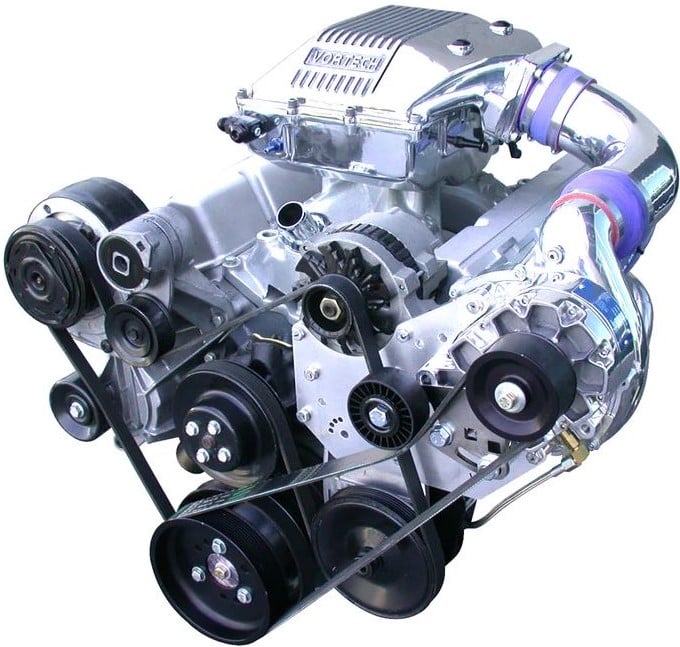
Some similar Vortech supercharger options offer higher boost ratings. For example, the Vortech V-1 Ti-Trim GM Supercharger Kit provides similar functionality but with 8-10 PSI at 5,500 RPMs. At JEGS, we carry them all in stock, and we have trusted experts to help you get your ducks in a row.
Most problems with a 350 small block supercharger trace back to a few avoidable mistakes. Here's what to watch for before and after the install.
Not sure your combination is ready? Give us a call at 1-800-345-4545, and a JEGS Tech Specialist can go over your exact setup.
A supercharged small block Chevy can make big gains, but only if you set it up right. Prep the engine first with fuel, tuning, and cooling upgrades, plus a compression check.
On a stock 350, stay in the 5-7 PSI range and treat about 450 hp as your reliable ceiling. Choose a roots-style blower for low-end torque or a centrifugal unit for top-end pull.
When you're ready, shop our full selection of superchargers, kits, and components below. Want more build help? Check out our guide to Chevy 350 power upgrades.
Yes, a stock 350 handles about 5-7 PSI well with fuel system upgrades and a proper tune. If you're starting fresh, compare the best 350 small block crate engines.
Depending on PSI and your other engine upgrades, expect to gain between 150 and 350 horsepower. The Vortech V-3 Si-Trim adds over 100 horsepower at modest boost, while bigger gains call for stronger internals like forged connecting rods.
Not if you're a prepared DIYer. With a few hours, the right tools, and the supercharger's manual, the install is straightforward, especially with our small block Chevy torque specs handy.
Yes, the 5.7-liter small block Chevy displaces 350 cubic inches. You'll see both names used for the same engine, including many Chevrolet Performance crate engines.
Yes, with a blow-through setup or one of the performance carburetors built for boost, plus a fuel system and tune to match. Our guide to choosing the right carburetor can help.

Does Edelbrock provide an E-Force 122 conversion manifold that fits directly on SBC Vortech iron heads like 062 part number, aka 855s?

Barry, the standard Edelbrock E-Force 122 systems for small block Chevy applications were generally designed around traditional SBC intake bolt patterns, so fitment on Vortec iron heads like the 062 or 906 castings is where things get tricky. The Vortec heads use a different intake bolt pattern and intake port design compared to earlier small block Chevy heads.
Because of that, a standard non-Vortec E-Force manifold will not bolt directly onto factory Vortec heads without an adapter setup, and even then clearance and alignment can become an issue. Edelbrock has offered Vortec-specific intake manifolds in other product lines, but for the E-Force 122 specifically, compatibility depends heavily on the exact kit generation and manifold casting.
You’ll also want to consider the airflow limitations of the factory Vortec iron heads if you’re planning to push boost levels. They work very well for mild to moderate street performance, but the overall combination matters.
At this point, the safest move is to verify the exact E-Force system generation and intended cylinder head compatibility before purchasing or modifying anything. Give us a call at 1-800-345-4545 and a Tech Specialist can help confirm which Edelbrock supercharger setups, manifolds, or adapter solutions will work best with your 062 Vortec heads.

I am looking to put a supercharger on my 5.7 marine 350 vorti have in my 2002 s10 truck,6ft bed. Wanted to get the edelbrock unit, but seen the vortec one and like that . What would you recommend
Hi Thomas, that’s a great setup you’ve got there. Since you’re running a 5.7L marine-based Vortec 350 in your 2002 S10, you already have a strong bottom end for boost, but choosing the right supercharger depends a lot on how you plan to use the truck and what kind of drivability you want.
Edelbrock’s supercharger systems are great for daily driving and mild performance builds because they use a roots-style blower design that makes strong low-end torque and delivers power smoothly. They’re well-engineered and tend to be very reliable, especially if you want something that fits under the hood and keeps a stock-like appearance.
The Vortech system, on the other hand, is a centrifugal-style supercharger. It behaves a bit differently, building boost with RPM rather than right off idle. That means you’ll get a softer hit off the line but much stronger pull on the top end. For your 350 Vortec, the Vortech setup can make excellent power without the heat soak that roots-style blowers can have, and it’s a good fit if you’re looking for more aggressive acceleration or plan to spin it higher.
Since you’re working with a marine engine in a street truck, I’d also make sure your compression ratio and fuel system are compatible with whichever setup you choose, especially if you’re planning to run higher boost levels. Both Edelbrock and Vortech make complete systems designed for small block Chevys, so you won’t have to piece everything together from scratch.
You can call us at 1-800-345-4545 and speak to one of our tech specialists who can go over your exact setup and help you choose the best supercharger system for your S10 build.

Leave a Reply