|
|||
Exhaust SystemsExhaust PartsIf you're thinking about adding some performance to your vehicle, an exhaust system is a good way to go. For today's modern muscle cars, you'll be dealing with a few things that old school hot rodders don't have to worry about. Most OEM catalytic converters do not flow exhaust very well. Depending on your performance and sound requirements, you may choose several options. An exhaust system is made up of some or all of these parts: A set of exhaust manifolds or headers, Down Pipe (exhaust manifold to catalytic converter), catalytic converters, X-pipe or H-pipe, mufflers, muffler back pipe and exhaust tips. You may have some of these exhaust parts or all of them. Most quality exhaust systems include pipes that are mandrel bent so they are the same diameter throughout the pipe curve/bend and aren't collapsed. Remember: You must comply with local, state and national regulations on exhaust product upgrades and changes. Not all exhaust products are 50 state legal.Headers Back Exhaust Kits
Cat Back Exhaust Systems
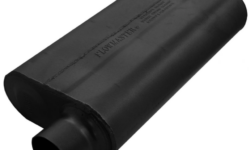
Exhaust Pipe Diameter"Bigger is Better" is something we all hear as hot rodders all the time, but is certainly not the case when selecting the correct exhaust pipe diameter. The only part that holds true to this mantra is that bigger is louder. Low end performance requires backpressure in an exhaust system. This backpressure is created by the restrictions in the exhaust pipe itself and helps pull spent exhaust gasses instead of having the engine push them out. This trait is called scavenging. When you choose a pipe diameter that is too big or an exhaust system that is too free flowing, often you will lose a noticeable amount of low end performance since the exhaust system is no longer providing a scavenging effect. This is because the engine has to use power that would normally go to the wheels to push these gasses out of the engine. Generally, gasoline V8 engines making less than 500 horsepower will perform best with a single 3" system or a dual 2.5" system. Gasoline engines producing over 500 horsepower will perform best with a single 3.5" or 4" pipe or a dual 3" exhaust system. Diesel performance differs greatly when selecting the correct exhaust pipe size. The exhaust pipe size can be used to raise and/ or control the exhaust gas temperatures (EGT) of the engine which can lead to much more performance. Diesel exhaust systems will commonly be much larger, often up to 6? diameter for higher horsepower applications, but there is a ceiling in this arena as well. Generally speaking, with a larger exhaust pipe more fuel that can be added to make more power. This mixture of fuel and exhaust flow helps maintain the EGT?s but if the proper amount of fuel is not added with the increase in pipe size, severe engine damage may result. Whether it be a gasoline or diesel application, it is never advantageous to run a ?straight pipe? exhaust system without some sort of muffler. The only exception would be high RPM race application. H and X PipesH Pipes became known in the mid 80?s most commonly on the Ford (fox chassis) Mustang. The problem with a dual exhaust system on a dual bank engine such as a V6 or V8 is that there was no way to balance the exhaust cylinder pulses that enter the H-pipe. This H-pipe is a short section of pipe installed perpendicularly into a dual exhaust system that connects the two pipes and helps balance the exhaust pulses from bank to bank. The scavenging effect mentioned earlier is also enhanced by an H pipe as the exhaust system now has twice as many cylinder pulses to work with. X-pipes are a later off shoot of the H-pipe concept and are often found to provide even better scavenging than a conventional H-Pipe. If you are thinking of installing one of these pipes, do it. They are a great addition to any exhaust system. H and X Pipes can be purchased by application, universally or built into many catback systems. Contrary to what you might think, both styles balance pipes will make the overall exhaust system quieter than without. MufflersMufflers are wide open! There are hundreds to choose from. Mufflers vary in loudness and tone so you can buy the mufflers you like. You can get steel, aluminized metal, stainless steel and polished stainless steel mufflers. Stainless usually costs more, but will outlast most other types of mufflers. Common muffler inlet and outlet diameters for V8 gas and small truck diesel engines are 2.25", 2.5", 3", 3.5" and 4". Most mufflers are specified by the inlet size and the outlet size. Mufflers may have one inlet pipe and 1 or 2 exit pipes to run dual tailpipes. Inlet and outlet position can vary. A muffler that is labeled "Center In" or "Center Out" means the inlet or outlet pipe on the muffler is centered on the muffler body. A muffler labeled "Offset In" or "Offset Out" means the inlet or outlet pipe is offset on the muffler body. Some are cylindrical while others are more rectangular shaped. The physical dimensions of a muffler typically effect the sound and performance. Catalytic ConvertersOEM catalytic converters aren't usually meant to flow exhaust as we would like them to. Step up to a high flow set of catalytic converters to relieve the back pressure on your system. If you want your exhaust to flow better, you can't have an exhaust system with any limitations in it. Many high flow cats are available in stainless steel for long lasting performance. Please Visit Our Headers Article for More Information on Selecting the Right HeadersShop For Exhaust Products |

|||